

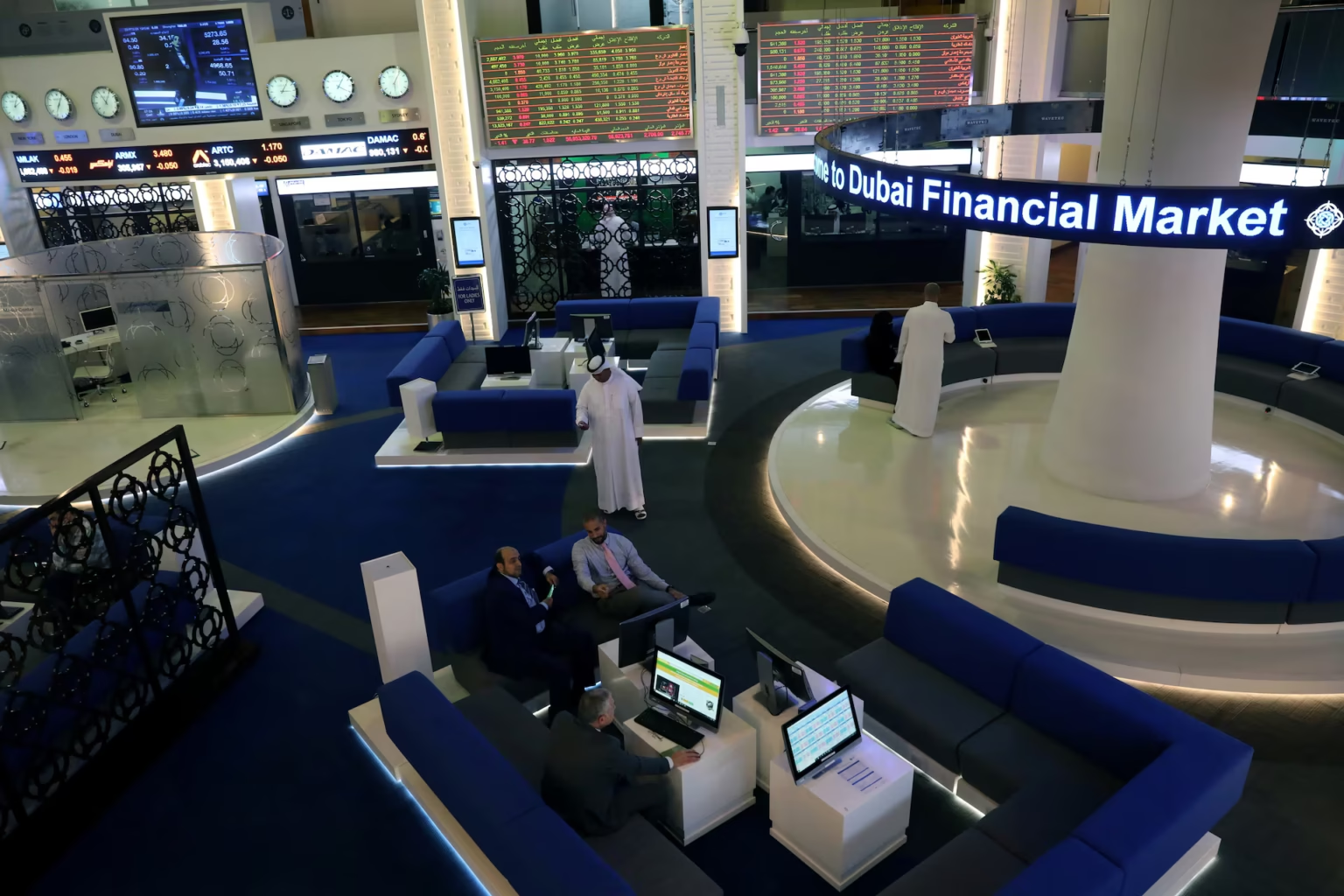
End-of-Year Trading in Gulf Markets reflects a clear shift toward caution as December approaches its close. Across major exchanges in Saudi Arabia, the UAE, Qatar, Kuwait, Bahrain, and Oman, investors have gradually reduced their appetite for risk. Instead of pursuing aggressive gains, market participants are focusing on capital preservation, balance-sheet strength, and long-term stability.
This shift is not necessarily a sign of weakness. Instead, it reflects a mature and disciplined market behavior shaped by global economic uncertainty, year-end portfolio rebalancing, and a desire to lock in profits earned earlier in the year. As trading volumes soften and volatility eases, the Gulf markets are entering a period of calm consolidation that could lay the groundwork for renewed momentum in the year ahead.
Understanding the Year-End Investment Mindset
The final weeks of December often bring a psychological shift among investors. Many institutional players close their books, reassess annual performance, and prepare strategic allocations for the upcoming year. In this environment, risk-heavy trades tend to take a back seat.
In the Gulf region, this mindset is reinforced by several factors. Fund managers aim to protect year-end returns, retail investors become more selective, and speculative activity declines. As a result, markets move more slowly, with price action driven by fundamentals rather than sentiment-fueled rallies.
This behavior is widely considered healthy. It reduces excessive volatility and encourages a more realistic valuation of assets, especially after periods of strong performance earlier in the year.
Slower Momentum Reflects Strategic Caution, Not Fear
Reduced risk appetite does not equate to panic selling. Instead, it signals thoughtful decision-making. Investors are trimming exposure to high-beta stocks, locking in profits, and reallocating funds toward defensive sectors such as banking, utilities, telecommunications, and consumer staples.
Across Gulf exchanges, this selective selling has resulted in modest index movements rather than sharp corrections. Blue-chip stocks continue to attract interest, while companies with strong dividends and stable cash flows remain favored.
This slower momentum reflects confidence in long-term prospects, even as short-term uncertainty encourages restraint. Investors are choosing patience over haste, a move that often proves beneficial during transitional periods.

Regional Market Behavior Across the Gulf
While the overall trend of reduced risk appetite is consistent, each Gulf market shows its own nuances.
In Saudi Arabia, the region’s largest market, trading activity has softened as investors reassess valuations after a year of mixed global signals. Banking and energy-related stocks continue to anchor the market, while growth-oriented sectors experience lighter trading.
The UAE markets, particularly Dubai and Abu Dhabi, display steady but selective participation. Real estate and financial stocks remain in focus, though investors are cautious about overextending positions before the new year.
Qatar’s exchange reflects similar stability, with long-term investors maintaining positions in core holdings. Kuwait, Bahrain, and Oman also show quieter trading sessions, characterized by low volatility and measured movements.
Overall, the regional picture is one of calm alignment rather than divergence.
Global Factors Reinforcing Conservative Moves
Global economic conditions play a crucial role in shaping year-end behavior. Persistent inflation concerns, evolving interest rate expectations, and geopolitical uncertainties continue to influence investor sentiment worldwide.
For Gulf investors, these external factors encourage prudence. While regional economies remain resilient, interconnected global markets mean that international developments cannot be ignored. As a result, many investors prefer to wait for clearer signals before committing fresh capital.
This wait-and-watch approach is especially common during December, when liquidity naturally thins and major announcements are deferred until the new year.
Profit Booking and Portfolio Rebalancing Take Center Stage
One of the most significant drivers of reduced risk appetite is profit booking. After months of trading, investors often choose to secure gains rather than risk late-year reversals. This leads to selective selling, particularly in stocks that have outperformed.
At the same time, portfolio rebalancing becomes a priority. Investors adjust asset allocations to align with risk tolerance, regulatory requirements, or strategic goals for the coming year. This process can temporarily slow market momentum but contributes to healthier long-term positioning.
Such disciplined activity underscores the growing sophistication of Gulf market participants.
Liquidity Patterns and Their Impact on Trading
Liquidity typically declines toward the end of the year as institutional investors reduce activity and many market participants step away for holidays. Lower liquidity can amplify price movements, which further encourages caution.
In response, investors often avoid large trades and favor incremental adjustments. This results in narrower trading ranges and fewer dramatic swings, reinforcing the overall atmosphere of stability.
For long-term investors, this environment offers opportunities to observe market behavior without the pressure of rapid fluctuations.
Defensive Sectors Gain Increased Attention
As risk appetite softens, defensive sectors naturally attract greater interest. Banks with strong balance sheets, companies offering consistent dividends, and businesses tied to essential services become preferred choices.
In the Gulf, financial institutions play a central role in this shift. Their steady earnings, regulatory oversight, and dividend potential align well with year-end priorities. Similarly, infrastructure-linked and consumer-focused companies benefit from predictable demand, even during slower trading periods.
This rotation highlights a preference for reliability over rapid growth as the year concludes.

Investor Confidence Remains Intact Beneath the Surface
Despite the cautious tone, investor confidence in the Gulf region remains fundamentally strong. Economic diversification efforts, government-backed projects, and long-term development strategies continue to support optimism.
Reduced risk appetite should therefore be seen as a temporary adjustment rather than a loss of faith. Many investors are simply waiting for the new year to deploy capital with renewed clarity and conviction.
This underlying confidence helps explain why markets remain stable rather than sliding into prolonged downturns.
What Year-End Behavior Signals for the Coming Year
Historically, calm and disciplined year-end trading often precedes more active participation in the first quarter of the new year. Once portfolios are reset and strategic outlooks clarified, investors tend to return with fresh energy.
For the Gulf markets, this suggests potential opportunities ahead. Early indicators for the upcoming year may emerge as trading volumes gradually recover and investors reposition themselves for growth themes, infrastructure spending, and regional expansion.
The current phase of reduced risk appetite can therefore be viewed as a pause that refreshes rather than a sign of stagnation.
Opportunities Hidden Within Market Calm
Periods of low momentum often reward patient and observant investors. Stable prices allow for careful analysis, accumulation of quality stocks, and strategic planning without the distraction of excessive volatility.
For retail investors especially, year-end calm provides a chance to learn from market movements, review past decisions, and set realistic goals. Institutional investors, meanwhile, use this time to refine models and prepare for broader participation in the months ahead.
In this sense, reduced risk appetite creates space for smarter, more intentional investing.
How End-of-Year Trading in Gulf Markets Slows Momentum
Reduced risk appetite during end-of-year trading in Gulf markets does not reflect fear. Instead, it points to calculated decision-making. Investors trim high-volatility positions, secure profits, and reallocate funds toward defensive sectors.
Market indices move within narrower ranges, avoiding sharp corrections. Blue-chip stocks with stable earnings and dividend strength continue to attract attention.
This slower momentum reinforces confidence by prioritizing sustainability over speed.
How End-of-Year Trading in Gulf Markets Slows Momentum
Reduced risk appetite during end-of-year trading in Gulf markets does not reflect fear. Instead, it points to calculated decision-making. Investors trim high-volatility positions, secure profits, and reallocate funds toward defensive sectors.
Market indices move within narrower ranges, avoiding sharp corrections. Blue-chip stocks with stable earnings and dividend strength continue to attract attention.
This slower momentum reinforces confidence by prioritizing sustainability over speed.
How End-of-Year Trading in Gulf Markets Slows Momentum
Reduced risk appetite during end-of-year trading in Gulf markets does not reflect fear. Instead, it points to calculated decision-making. Investors trim high-volatility positions, secure profits, and reallocate funds toward defensive sectors.
Market indices move within narrower ranges, avoiding sharp corrections. Blue-chip stocks with stable earnings and dividend strength continue to attract attention.
This slower momentum reinforces confidence by prioritizing sustainability over speed.
A Season of Stability Over Speculation
The closing weeks of December emphasize a core principle of investing: not every moment demands action. Sometimes, restraint itself is a strategy. Across Gulf markets, this philosophy is clearly on display.
By favoring stability, selective selling, and thoughtful positioning, investors are reinforcing market maturity. The absence of aggressive speculation helps preserve gains and maintain confidence as one year transitions into the next.
This steady approach reflects a region increasingly aligned with global best practices in financial market behavior.
Conclusion: Calm Today, Confidence Tomorrow
End-of-year trading in the Gulf markets paints a picture of composure rather than concern. Reduced risk appetite, slower momentum, and selective selling are not signs of weakness but indicators of thoughtful participation and strategic foresight.
As investors prioritize stability and prepare for the opportunities ahead, the region’s markets demonstrate resilience and discipline. This calm phase serves as a bridge between reflection and renewal, setting the stage for a confident start to the new year.
Do follow Gulf Magazine on Instagram.
Also Read – Regional Markets React to Global Economic Signals With Calm Confidence

