

The Dubai Police Digital Twin investigation has shed light on a tragic incident that once puzzled authorities and the public alike: was a motorcyclist’s fall from a bridge a suicide attempt or the result of a hit-and-run? Using advanced simulation technology, investigators reconstructed the event in stunning detail and uncovered the truth — demonstrating how modern policing is evolving in the age of smart cities.
In recent years, law enforcement agencies worldwide have adopted new tools such as artificial intelligence, data analytics, and digital modeling. But this case stands out because it shows how a “Digital Twin” — a virtual replica of a real-world environment — can answer questions that eyewitnesses, CCTV footage, and traditional forensic methods cannot.
The investigation conducted by Dubai Police in Dubai is now being studied as a model for future accident reconstruction and criminal investigations.
The incident that raised troubling questions
Late one night, emergency responders were called after a motorcycle rider fell from a high bridge onto the road below. The injuries were severe, and the circumstances were unclear. No clear witnesses came forward. Traffic was light, and surveillance footage captured only partial details.
Authorities initially faced two possibilities:
- The rider may have lost control and fallen accidentally
- Another vehicle could have struck the motorcycle and fled
- The fall might have been intentional
Each scenario carried serious implications — for justice, insurance claims, public safety, and the victim’s family.
Traditional accident reconstruction relies on skid marks, vehicle damage, injury patterns, and witness testimony. But in this case, physical evidence alone could not explain how the rider left the bridge.
Investigators needed something more precise.
What is Digital Twin technology?
The Dubai Police Digital Twin investigation used a technology originally developed for engineering, aviation, and urban planning.
A Digital Twin is a highly detailed virtual model of a real object or environment. It uses real-world data — measurements, materials, physics, traffic patterns, and environmental conditions — to simulate what happens under different scenarios.
For example, a digital twin of a bridge includes:
- Exact dimensions and structure
- Surface friction and slope
- Traffic flow patterns
- Weather and lighting conditions
- Vehicle speeds and positions
- Impact physics
By recreating the scene digitally, investigators can test multiple possibilities without disturbing evidence.
In smart cities like Dubai, extensive sensor networks and high-resolution mapping make such modeling incredibly accurate.
Why traditional evidence was not enough
Initial analysis revealed puzzling inconsistencies.
There were no clear braking marks from the motorcycle. Damage to the bike suggested a sudden loss of balance rather than a long skid. CCTV footage showed the rider approaching normally but did not capture the exact moment of the fall due to camera angles.
Investigators also examined the victim’s background to determine whether suicide was likely. However, personal circumstances alone cannot confirm intent.
Without proof of another vehicle’s involvement, authorities faced a dead end.
This is where the Digital Twin approach became crucial.
Rebuilding the scene virtually
Engineers and forensic experts created a complete digital replica of the bridge and surrounding roadway.
They gathered data from multiple sources:
- Traffic cameras
- Road design blueprints
- GPS data
- Vehicle specifications
- Medical reports on injuries
- Weather records
- Surface conditions at the time
The model even simulated nighttime lighting, which can affect depth perception and reaction times.
Next, investigators recreated the motorcycle’s movement frame by frame.
Testing every possible scenario
Using the digital model, experts simulated numerous situations:
Scenario 1: Rider loses control on their own
In this simulation, the motorcycle swerved due to rider error or mechanical failure. The model showed that losing control at that speed would likely result in sliding along the road surface — not vaulting over the barrier.
This outcome did not match the real injuries or the location where the bike was found.
Scenario 2: Intentional jump
If the rider had deliberately steered toward the edge, the trajectory would be different. Simulations suggested a direct approach angle and specific acceleration pattern that was not observed in available footage.
Again, evidence did not fully support this theory.
Scenario 3: Collision with another vehicle
When experts introduced a second vehicle into the simulation — particularly one approaching from behind or alongside — the results began to align with reality.
A sudden side impact could destabilize the motorcycle instantly, leaving little time for braking. The rider could be thrown upward and over the barrier, explaining the fall.
This scenario also explained the absence of skid marks and the unusual damage pattern.
Discovering the hidden culprit
Further simulations refined the collision parameters: speed, angle, and vehicle type. Investigators compared these findings with traffic data and partial camera footage from nearby roads.
Eventually, they identified a suspicious vehicle that had passed through the area around the same time. Its movement patterns matched the simulation results.
Authorities tracked down the driver, who initially denied involvement. However, forensic analysis of the vehicle revealed damage consistent with the modeled impact.
The Digital Twin investigation had effectively recreated the invisible moment of collision.
From uncertainty to clarity
The conclusion was clear: the fall was not a suicide attempt. It was a hit-and-run accident.
This finding had profound consequences:
- The victim’s family received answers and closure
- Criminal charges could be pursued against the driver
- Insurance claims could be processed accurately
- Public trust in the investigation process was strengthened
Without the Digital Twin technology, the case might have remained unresolved.
Why this case matters beyond one incident
The Dubai Police Digital Twin investigation demonstrates how policing is entering a new era.
Modern cities generate enormous amounts of data — from cameras, sensors, vehicles, and infrastructure. When combined with advanced simulation, this data can reconstruct events with near-scientific precision.
Key advantages of Digital Twin investigations include:
- Ability to test multiple scenarios safely
- Reduction of human bias
- Preservation of evidence
- Clear visual explanations for courts
- Faster resolution of complex cases
Such technology is especially valuable when eyewitness accounts are unreliable or absent.
Applications beyond traffic accidents
While this case involved a bridge fall, Digital Twin systems can be used in many areas of law enforcement and public safety:
Crime scene reconstruction
Investigators can recreate shootings, explosions, or structural collapses to understand how events unfolded.
Disaster response planning
Authorities can simulate floods, fires, or building evacuations to improve preparedness.
Infrastructure safety
Engineers can test how bridges, tunnels, and roads perform under stress before accidents occur.
Crowd management
Large events can be modeled to prevent stampedes or security risks.
Dubai, known for its smart city initiatives, is already integrating such technologies into urban planning.
Ethical considerations and privacy concerns
As powerful as Digital Twin systems are, they also raise important questions.
Using vast amounts of data — including surveillance footage and sensor inputs — must be balanced with privacy rights. Transparency in how data is collected and used is essential to maintain public trust.
There is also the risk of over-reliance on technology. Simulations are only as accurate as the data they receive. Human oversight remains crucial.
The human side of the story
Behind every investigation lies a personal tragedy. For the victim’s family, uncertainty can be as painful as loss itself.
Knowing whether a loved one died by accident, crime, or intentional act carries deep emotional consequences. In this case, technology helped restore dignity to the victim by revealing that they were not responsible for their own death.
It also ensured accountability for the driver who fled the scene.
A glimpse into the future of policing
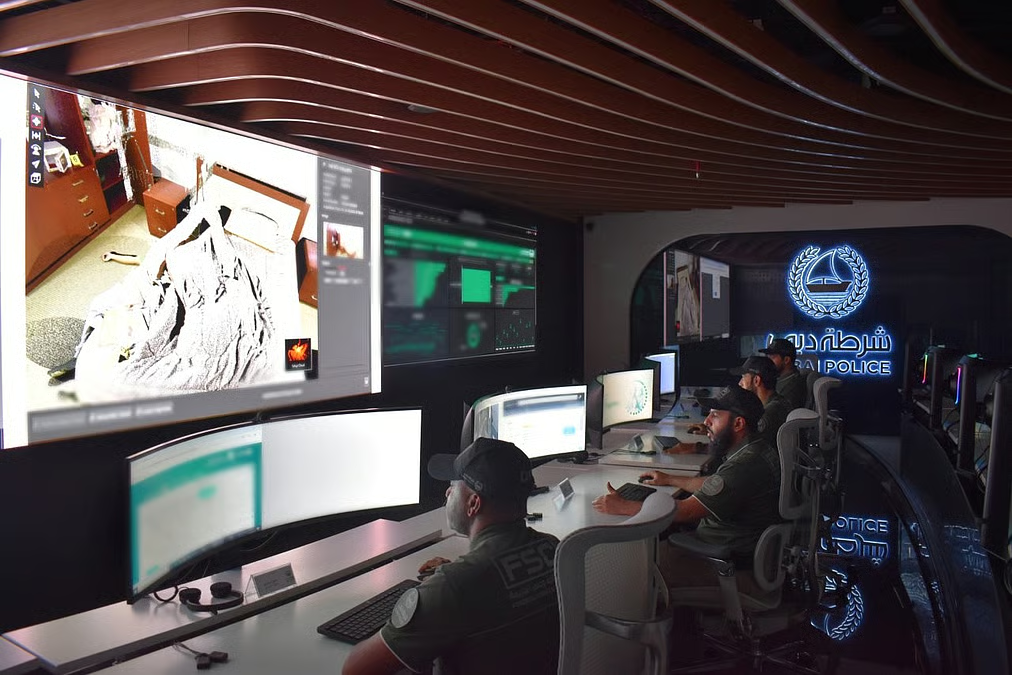
Experts believe Digital Twin technology will become standard in major cities over the next decade.
Future systems may integrate:
- Real-time traffic monitoring
- Autonomous vehicle data
- Wearable device information
- AI-driven predictive modeling
- Drone surveillance inputs
Investigations that once took months could be resolved in days.
The Dubai Police Digital Twin investigation is already being cited as a pioneering example of this transformation.
Lessons for other countries
Many nations, including rapidly urbanizing regions, face challenges in traffic safety and accident investigation. Adopting advanced reconstruction tools could significantly improve justice outcomes.
However, implementation requires:
- High-quality data infrastructure
- Skilled technical teams
- Legal frameworks for digital evidence
- Public acceptance
Dubai’s success shows what is possible when technology and governance align.
Technology serving justice
At its core, the purpose of law enforcement is to uncover truth. Traditional methods — interviews, physical evidence, intuition — remain vital. But modern challenges demand modern solutions.
Digital Twin technology does not replace human investigators; it enhances their ability to see what cannot be seen.
In this case, it turned a mystery into a solvable puzzle.
Conclusion
The Dubai Police Digital Twin investigation into the rider’s bridge fall stands as a landmark moment in forensic science and smart policing. By recreating reality inside a virtual environment, investigators proved that the incident was a hit-and-run rather than suicide, bringing justice and clarity to all involved.
As cities become more connected and data-driven, such tools will likely play a growing role in public safety. While technology alone cannot prevent tragedies, it can ensure that when they occur, the truth does not remain hidden.
For the people of Dubai — and for observers worldwide — this case offers reassurance that innovation can serve humanity’s most fundamental need: understanding what really happened.
Do follow Gulf Magazine on Instagram
Also Read – Aspire Park: 7 Amazing Reasons to Visit This Green Paradise

