

Unveiling Oman’s Ancient Mysteries with Valentina Azzarà
Oman, a nation rich in history and culture, has long captivated archaeologists and historians alike. Its vast deserts, towering mountains, and ancient trade routes conceal stories of civilizations that thrived thousands of years ago. These hidden narratives, buried beneath the shifting sands, offer valuable insights into the evolution of human societies in the Arabian Peninsula.
One of the leading figures in uncovering these secrets is Dr. Valentina Azzarà, an esteemed archaeologist and honorary research fellow at Leiden University. For over two decades, she has dedicated her career to exploring Oman’s prehistoric landscapes, piecing together the lives of the people who once inhabited the region. Her extensive fieldwork and expertise recently earned her a feature in a National Geographic documentary, highlighting Oman’s rich archaeological heritage on an international stage.
A Journey Two Decades in the Making
Dr. Azzarà’s fascination with Omani archaeology began more than 20 years ago when she first set foot in the region as part of a research expedition. Since then, she has played a pivotal role in numerous archaeological projects, uncovering ancient settlements, burial sites, and artifacts that shed light on Oman’s early inhabitants.
Her work has provided groundbreaking evidence of prehistoric trade routes, social structures, and technological advancements. From studying early copper production to investigating Neolithic and Bronze Age settlements, Dr. Azzarà’s research has significantly contributed to understanding Oman’s role in ancient history. Her vast knowledge and dedication made her an ideal expert for National Geographic’s exploration of the region.
Behind the Scenes: Collaborating with National Geographic
Dr. Azzarà’s collaboration with National Geographic was the result of a meticulous process. The production team first reached out while she was conducting fieldwork at a key site in Oman. Recognizing the potential to showcase the importance of these archaeological discoveries, extensive discussions took place over nearly a year. Numerous emails, virtual meetings, and detailed planning sessions ensured that the documentary would be both engaging and scientifically accurate.
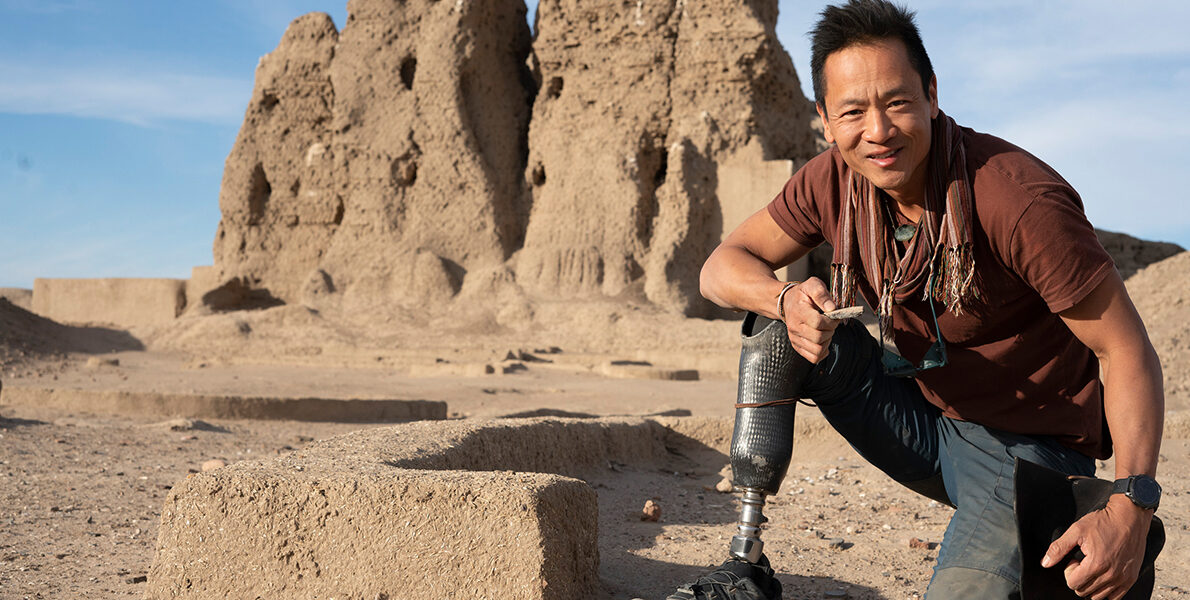
The filming took place in December 2022 under a tight schedule. Dr. Azzarà arrived on a Friday evening and departed by Sunday, with the primary shoot occurring on Saturday. The production team, led by renowned presenter Albert Lin, included specialists such as technicians, archaeologists, data analysts, and logistics experts. Together, they aimed to present an immersive and visually compelling journey into Oman’s past.
The Filming Experience: Challenges and Insights
While participating in the documentary was an exciting opportunity, it also came with its challenges. The fast-paced nature of the shoot required multiple retakes to refine the narrative. Dr. Azzarà, committed to academic integrity, found herself occasionally correcting historical inaccuracies to ensure that the information presented to viewers was authentic.
The documentary employed cutting-edge technology to enhance its storytelling. LiDAR scanning, thermal imaging, and Ground Penetrating Radar (GPR) were utilized to reveal hidden structures beneath the surface. These tools have revolutionized archaeology, allowing researchers to uncover ancient remains without disturbing the site. However, due to the rapid filming schedule, much of the data analysis was left for post-production, limiting the immediate findings available on-site.
Reflections on the Documentary’s Narrative
Upon viewing the final documentary, Dr. Azzarà noted a shift towards an adventure-driven narrative, designed to captivate a broad audience. While this approach makes history more accessible, it sometimes risks oversimplifying complex archaeological interpretations.
For instance, one segment suggested that Omani populations were among the first to develop copper smelting techniques. However, current research indicates that early metallurgy likely originated in regions such as Iran or Anatolia before spreading to Oman. Additionally, claims of direct links between Omani civilizations and ancient Egypt are not strongly supported by existing archaeological evidence. While such theories make for compelling storytelling, they must be approached with caution to avoid misrepresenting historical facts.
The Importance of Public Engagement in Archaeology
Despite the challenges of simplifying academic research for mainstream media, Dr. Azzarà acknowledges the value of documentaries in sparking public interest in archaeology. Television and digital media serve as powerful platforms to connect audiences with ancient history, fostering a greater appreciation for cultural heritage.
However, she emphasizes the need for a balanced approach that respects scholarly accuracy while maintaining engaging storytelling. In an era of rapidly accessible information, it is crucial to ensure that historical narratives are conveyed responsibly, preventing the spread of misinformation and fostering informed discussions about the past.
Oman’s Rich Archaeological Landscape
Oman is home to an array of archaeological sites that date back thousands of years. Recent discoveries have further solidified its place as a significant center of ancient civilizations:
- 7,000-Year-Old Tomb near Nafūn: In central Al Wusta province, archaeologists discovered a stone tomb containing the remains of dozens of individuals. Dating between 5000 B.C. and 4600 B.C., this site provides valuable insights into ancient burial customs and early community structures.
- Early Bronze Age Structure in Al Gharyein: A team from Sultan Qaboos University uncovered a vast building measuring over 550 square meters in Wadi Andam, North Sharqiyah. Dating back over 4,500 years, it stands as one of the largest non-tower structures from the Early Bronze Age in the region, suggesting a well-organized society with complex architecture.
- Sophisticated Settlement in Rustaq: Excavations in Rustaq revealed a 4,000-year-old settlement spanning more than 70 hectares. The site includes domestic buildings, circular tombs, and traces of copper production, indicating advanced trade networks and technological development.
Conclusion
Dr. Valentina Azzarà’s involvement in the National Geographic documentary has brought global attention to Oman’s extraordinary archaeological heritage. While the documentary successfully showcases the country’s rich history, it also highlights the ongoing challenge of balancing academic rigor with engaging storytelling.
As the world continues to uncover the mysteries of ancient civilizations, it is vital to approach these narratives with a critical and informed perspective. Documentaries, when crafted responsibly, serve as valuable tools in educating and inspiring audiences, ensuring that the voices of the past continue to be heard and understood in the modern age.
Do follow gulf magazine on Instagram
for more information click here

