

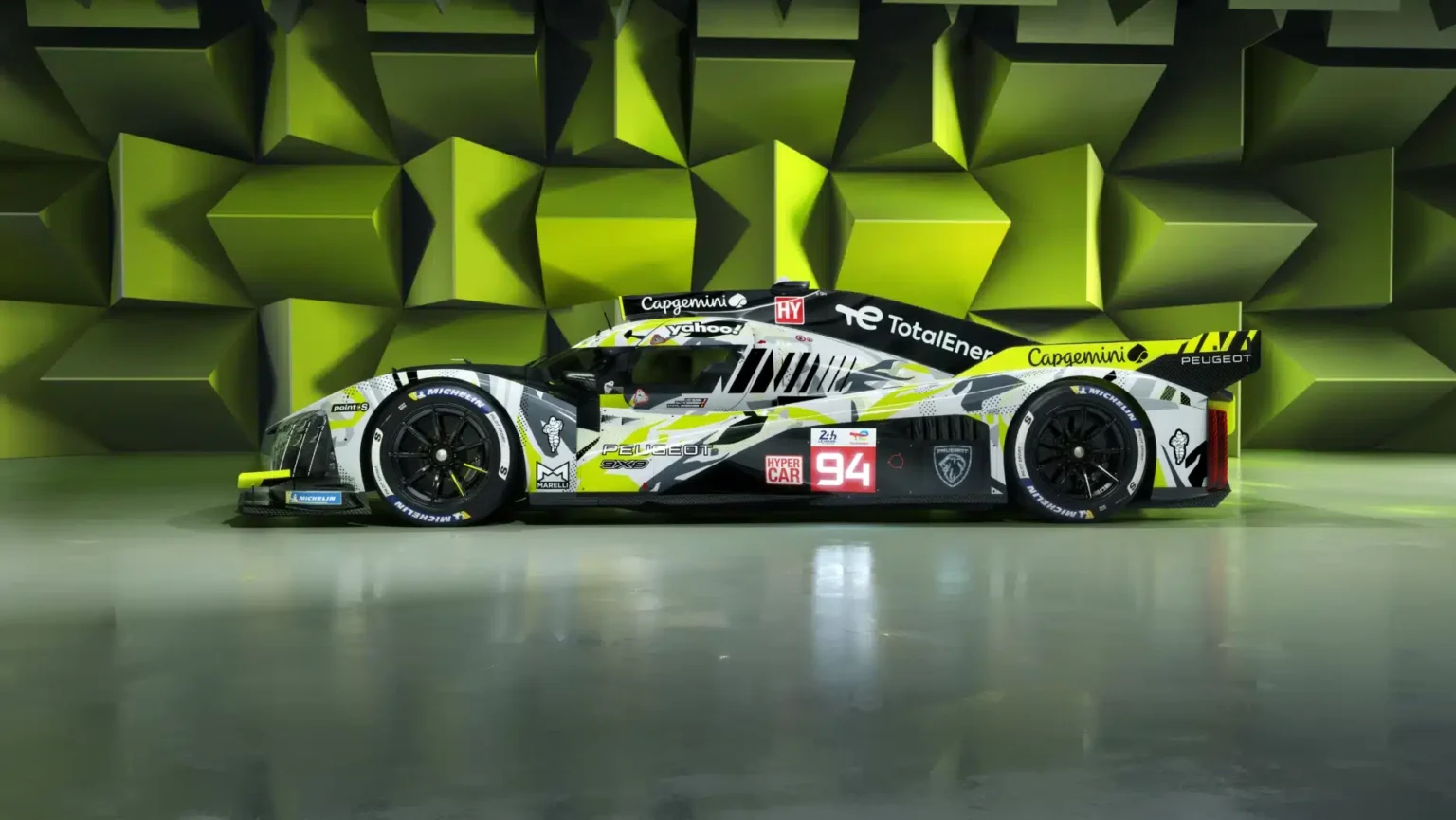
The 2025 FIA World Endurance Championship (WEC) kicked off with an electrifying Qatar 1812 km race at Lusail International Circuit on February 28. This highly anticipated season opener brought together some of the best endurance racing teams, with the Hypercar and LMGT3 categories featuring world-class competition. Amidst the battle for supremacy, Peugeot’s 9X8 Hypercars delivered a consistent and reliable performance, signaling an encouraging start to their campaign.
Race Overview: A Fierce Start to the WEC Season
The Qatar 1812 km event featured a competitive grid of 36 cars, evenly split between the top-tier Hypercar and LMGT3 classes. In the Hypercar category, AF Corse dominated the podium with an impressive 1-2-3 finish, showcasing Ferrari’s growing strength in endurance racing. The #83 Ferrari, driven by Robert Kubica, Yifei Ye, and Philip Hanson, clinched a commanding victory, completing the 10-hour race in 9 hours, 1 minute, and 18.578 seconds. The sister cars, #50 and #51 Ferraris, closely followed in second and third place, respectively, making it a perfect weekend for the Italian manufacturer.
For Peugeot, the race provided a vital test of their 9X8 Hypercars’ performance, reliability, and strategic execution. While they did not contend for podium positions, their strong showing in reliability and strategy highlighted their potential for future rounds.
Peugeot’s Performance: A Step Forward in Reliability
Peugeot entered the Qatar race with two 9X8 Hypercars, demonstrating resilience throughout the endurance event. The #93 car, driven by Jean-Eric Vergne, Paul di Resta, and Mikkel Jensen, managed to secure a respectable 9th-place finish. Meanwhile, the #94 entry, piloted by Loic Duval, Gustavo Menezes, and Nico Müller, finished 12th after receiving a costly penalty that pushed them out of points contention.
Despite finishing in the midfield, the reliability of the 9X8 Hypercars stood out as a key takeaway. Both cars completed the grueling race without major mechanical issues, a crucial factor in endurance racing. This performance signified progress for Peugeot, as they continue refining their package to compete with the top-tier manufacturers.
Team Insights: Positive Takeaways and Areas for Improvement
Jean-Marc Finot, Senior Vice President of Stellantis Motorsport, praised the team’s reliability and execution:
“The two cars finished, and they were very reliable in this 10-hour race, which is a positive point because we had to rebuild #94 before qualifying. We extracted the maximum from the package we had during the race and took advantage of all opportunities and safety cars to reposition ourselves in the standings. I am very proud of the work of the entire team this week. Now, we need to find a bit more pace to more regularly compete for the top spots.”
Olivier Jansonnie, Technical Director of Peugeot Sport, acknowledged the challenges faced during the race:
“It was a pretty complicated race, and very tight in the middle of the pack. Losail is a circuit that doesn’t degrade tyres much, so no issues with the tyre quota here. However, the track changes a lot, and we had to find the right tire combinations depending on the conditions, while trying to outmaneuver the competitors within our reach and make the best use of the safety cars to keep both our cars in the lead lap as long as possible.”
Race Dynamics and Challenges: A Strategic Battle
Endurance racing is not just about speed—it’s a test of strategy, adaptability, and resilience. The Qatar 1812 km was a perfect example of this, with the race being interrupted ten times due to virtual safety cars, full-course yellows, and traditional safety car deployments. These disruptions forced teams to continuously adjust their strategies, seizing any advantage that presented itself.
Peugeot’s strategic execution allowed them to remain competitive, ensuring their cars stayed on the lead lap for as long as possible. However, the competition was fierce, with manufacturers like Toyota, Porsche, and Cadillac also vying for top positions. Notably, Cadillac encountered significant internal issues, as their two JOTA entries collided under safety car conditions, emphasizing the unpredictable nature of endurance racing.
Tyre Management: A Crucial Factor at Lusail
Lusail International Circuit presented a unique challenge in terms of tyre management. Unlike other endurance tracks that cause significant tyre degradation, Lusail’s surface allowed teams to extend tyre life, reducing the impact of the limited tyre allocation per race.
Peugeot had to make critical decisions regarding tyre choices based on fluctuating track conditions. Mikkel Jensen, co-driver of the #93 Peugeot, elaborated on their strategic tyre approach:
“I did a first double stint of more than two hours. Between day and night, temperatures dropped, and the track evolved a lot. It was hard to know whether to use hard or medium tyres at that point. We chose to run hard on the left and medium on the right. We weren’t the fastest on track, but we stuck with it to stay in the top-10 and on the lead lap.”
Looking Ahead: Peugeot’s Next Steps in WEC 2025
With the Qatar 1812 km race concluded, Peugeot now turns its attention to the upcoming 6 Hours of Imola in April. The focus will be on refining the performance of their 9X8 Hypercars to achieve a better competitive edge against the leading teams.
While Peugeot’s pace may not yet be at the level of Ferrari, Toyota, or Porsche, their strong reliability at Lusail sets a solid foundation for the rest of the season. If they can extract more speed while maintaining their durability, Peugeot could become a serious contender in the 2025 WEC season.
Conclusion: A Promising but Challenging Road Ahead
Peugeot’s performance at the Qatar 1812 km race may not have delivered a podium, but their reliability and strategic execution were key positives. Endurance racing is a marathon, not a sprint, and Peugeot’s consistent finish at Lusail proves they are on the right track.
The team’s engineers and drivers will now analyze their Qatar performance, looking for improvements in race pace and tyre management. With further development and strategic refinements, Peugeot has the potential to move up the grid and challenge the dominant teams as the season progresses.
The next race at Imola will be another test of Peugeot’s competitiveness in the 2025 WEC season. Motorsport fans will be eager to see if they can convert their reliability into a stronger race result. For now, Peugeot can take pride in their progress and set their sights on building a more competitive race package in the coming months.
Do follow gulf magazine on Instagram
for more information click here

