


In recent years, the United Arab Emirates (UAE) has emerged as one of the world’s most attractive destinations for foreign universities to establish campuses. Today, the UAE is home to the highest number of international branch campuses in the Middle East. This move is part of a growing trend where top universities from countries like the United Kingdom, the United States, Australia, and India are setting up shop in the Gulf nation.
But what’s really behind this educational migration to the UAE? The reasons go far beyond just beautiful architecture or flashy cities. A mix of government incentives, regional demand for high-quality education, strategic geography, and the UAE’s ambition to build a knowledge-based economy all play a part.
Let’s explore why the UAE has become the new playground for global higher education institutions.
A Government That Welcomes the World
One of the biggest reasons foreign universities are entering the UAE market is the strong backing from the government. Authorities have made it incredibly easy and attractive for global institutions to open campuses in the country. Education-focused free zones like Dubai International Academic City (DIAC) and Abu Dhabi’s Education Hub are designed specifically to support international institutions.
These zones offer benefits like tax exemptions, 100% foreign ownership, and simplified visa processes for both students and faculty. In addition, the government provides infrastructure, logistical support, and access to potential local and international students living in the UAE.
This business-friendly environment creates a low-risk, high-reward scenario for universities looking to expand internationally. It allows them to test new markets without the heavy costs often associated with global expansion.
A Region Hungry for Quality Education
The Middle East has a rapidly growing young population, and many of them are seeking higher education. However, not all students can afford to study abroad due to financial or personal reasons. Bringing internationally recognized degrees closer to home solves this problem.
Foreign universities in the UAE offer the same courses, degrees, and teaching standards as their home campuses. This allows students to earn prestigious degrees without having to leave the region. For families in the Middle East, South Asia, and parts of Africa, this is an extremely attractive option.
Moreover, many students from surrounding countries, including India, Pakistan, Egypt, Nigeria, and even Central Asia, now view the UAE as a more affordable and culturally familiar alternative to the West.
The UAE’s Vision of a Knowledge Economy
The UAE is actively working to reduce its dependency on oil. As part of its Vision 2030 strategy, the country is investing in sectors like technology, renewable energy, tourism, and education. A knowledge-based economy is central to this long-term plan.
By welcoming foreign universities, the UAE is not just adding educational institutions—it is importing innovation, research, and intellectual capital. These universities bring with them new ideas, teaching styles, and cutting-edge research projects that help build a smarter and more capable local workforce.
The presence of global universities also enhances the country’s reputation as a forward-thinking and future-ready nation. This, in turn, attracts global businesses, investors, and talent.
A Strategic Global Education Hub
Geographically, the UAE sits at the crossroads of Asia, Europe, and Africa. Its central location makes it accessible to students from dozens of countries within just a few hours of flying time. This geographical advantage is one of the reasons the UAE has been able to position itself as a global education hub.
Additionally, cities like Dubai and Abu Dhabi offer world-class infrastructure, safety, and a cosmopolitan lifestyle, which adds to their appeal for international students. These cities are multilingual, multicultural, and offer a blend of tradition and modernity—making them ideal locations for global learners.
The UAE’s high ranking in global safety indexes and its stable political climate also give it an edge over other regions that may be more volatile.
The Role of EdTech and Online Learning
Another reason foreign universities are interested in the UAE is the country’s embrace of education technology. The COVID-19 pandemic accelerated digital transformation in the education sector worldwide, and the UAE adapted quickly. Universities are now experimenting with hybrid models—offering a mix of on-campus and online classes.
This allows global universities to start with smaller physical campuses while reaching a broader student base through digital platforms. It’s a flexible, scalable approach that lowers initial costs and allows them to build gradually.
What’s in It for the UAE?
For the UAE, having top universities within its borders boosts its global image, attracts foreign direct investment, and retains local talent. Instead of losing bright students to institutions abroad, the UAE can now keep them within the country.
Additionally, these campuses bring highly skilled faculty and researchers who contribute to local innovation and job creation. Many of these professionals end up collaborating with UAE-based companies and startups, sparking further development.
Not All Smooth Sailing
Despite the many positives, the growth of foreign campuses in the UAE is not without its challenges. One major concern is maintaining consistent academic quality. While many institutions strive to keep their standards as high as their home campuses, variations can occur.
There’s also growing competition—not just between foreign universities but between foreign and local institutions. As more players enter the market, attracting top students and staff becomes more difficult. Tuition costs, scholarship availability, and campus facilities will play a big role in determining who thrives.
Cultural alignment is another key area. Foreign universities must ensure they respect and understand the local norms, values, and laws, while still offering a globalized education.
The Future Looks Bright
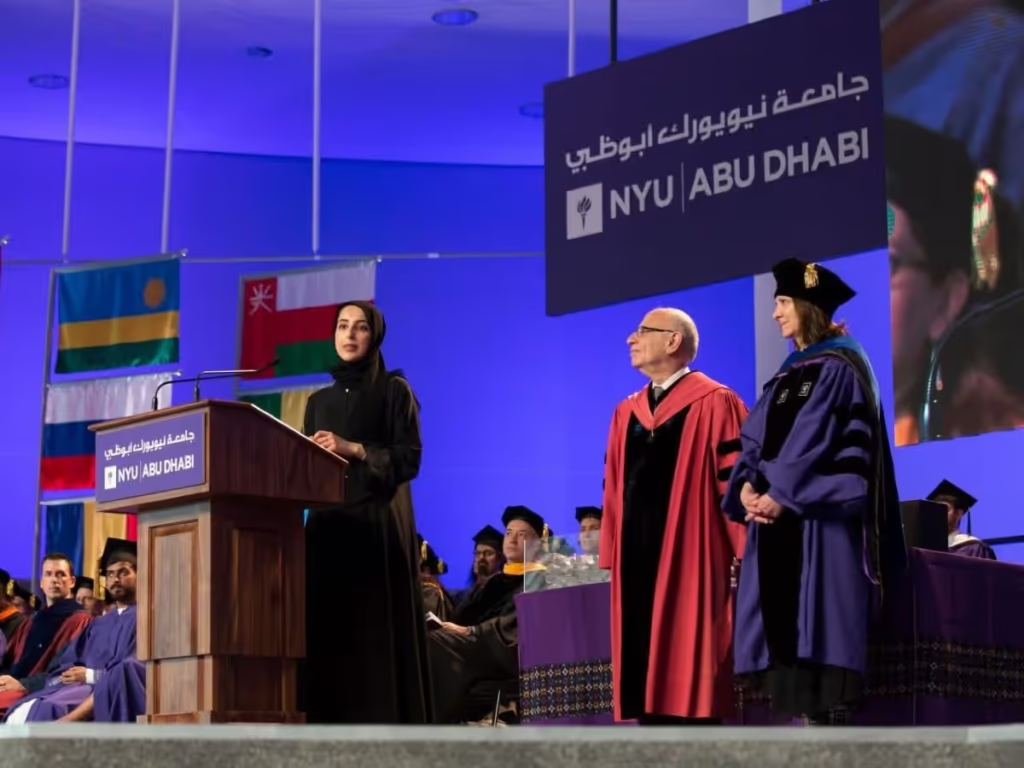
As the UAE continues to strengthen its education sector, we can expect more foreign universities to arrive. Already, institutions like New York University, University of Birmingham, and Sorbonne have set up in the UAE. Indian and Australian universities are also showing increasing interest.
The growing student base, government support, and economic strategy make this a win-win for both the UAE and foreign institutions. As long as the country continues to focus on quality, accessibility, and innovation, it will likely remain a preferred destination for global education for years to come.
Abdulaziz Kushalnagar, Respected Expat from Karnataka, Passes Away in Riyadh After 35 Years

