

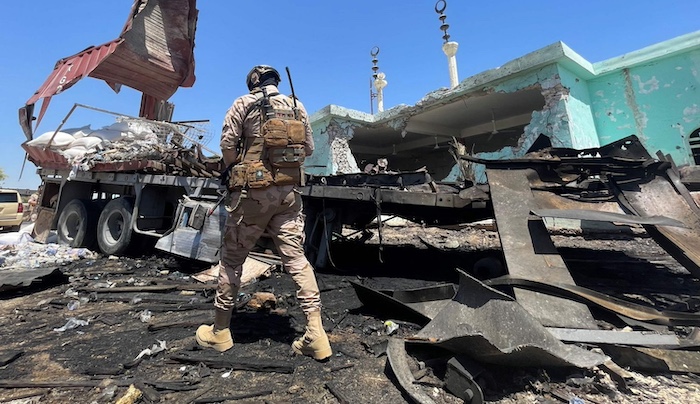
In a serious escalation of tensions in the Middle East, a U.S. military base in western Iraq was hit by rocket fire, leaving five American personnel injured Rocket Attack. U.S. defense officials confirmed that the attack targeted the Ain al-Asad airbase, a key hub for American forces in the region.
The strike, involving multiple rockets, is believed to have been carried out by Iran-aligned militia groups operating in Iraq. Officials have described the attack as a dangerous provocation at a time when regional stability is already under significant pressure.
How the Attack Happened
The rocket attack took place on Monday afternoon. According to military sources, two Katyusha rockets were fired at Ain al-Asad airbase, one of Iraq’s largest military installations hosting U.S. and coalition troops. While one rocket landed inside the base, causing damage and injuries, Iraqi forces were able to intercept a third rocket before it could hit its intended target.
Initially, it was reported that seven U.S. personnel had been hurt, but after a medical review, officials confirmed that five people had sustained injuries. These included four U.S. service members and one American contractor working with the military. Three of the injured were in serious condition and were airlifted to Landstuhl Regional Medical Center in Germany for advanced treatment. The remaining two received care on-site and have since returned to duty.
Who Is Responsible?
While no group has officially claimed responsibility for the attack, U.S. officials have pointed to Iran-backed Shia militias operating in Iraq. Groups like Kataib Hezbollah and Asaib Ahl al-Haq, known for their hostility toward U.S. forces, have a history of launching similar attacks.

Defense Secretary Lloyd Austin strongly condemned the assault, describing it as “a reckless and dangerous act” that further destabilizes the region. He emphasized that the United States reserves the right to defend its personnel and will respond appropriately to protect its forces.
Pentagon officials stressed that the attack fits a broader pattern of aggression linked to Iran and its network of proxy militias across the Middle East. These groups have grown increasingly emboldened following recent events that have fueled animosity against U.S. interests.
Iraqi Government’s Response
In a swift move, Iraqi security forces launched an investigation and managed to arrest five suspects connected to the attack. Authorities also seized a vehicle outfitted with a rocket launcher believed to have been used in the assault.
The Iraqi government condemned the attack, labeling it as a “reckless and irresponsible act” that not only threatens the lives of foreign troops but also endangers Iraq’s national security. Iraqi officials reiterated their commitment to protecting diplomatic and military missions on their soil and vowed to bring the perpetrators to justice.
Iraq’s leadership is walking a delicate line. While the government relies heavily on U.S. military support to combat remnants of extremist groups like ISIS, it also faces pressure from powerful militia factions that want all foreign forces expelled.
Rising Tensions in the Middle East
The attack comes at a time when tensions in the Middle East are already dangerously high. Just days earlier, senior leaders of Hamas and Hezbollah were assassinated in targeted strikes in Tehran and Beirut, respectively. These events have triggered outrage among Iran and its allied groups, who have vowed retaliation against U.S. and Israeli interests.
Analysts warn that attacks like the one at Ain al-Asad could become more frequent as Iran and its proxies seek to show strength and reassert influence in the region. The situation raises fears of a wider conflict that could draw in more international players.
In response to growing threats, the U.S. has recently increased its military presence in the region, deploying additional air defense systems, intelligence assets, and rapid response forces to bases in Iraq, Syria, and the Persian Gulf.
U.S. Troops in Iraq: A Brief Overview
Currently, about 2,500 American troops are stationed in Iraq as part of a broader coalition tasked with combating the Islamic State and providing training and advisory support to Iraqi forces.
Despite ongoing tensions, discussions between the U.S. and Iraqi governments have been moving toward a gradual drawdown of coalition forces. Plans had been in place to transition to a purely advisory role by the end of 2025, but incidents like the recent rocket attack may complicate those efforts.
Many Iraqis, including powerful political and militia leaders, have long demanded the expulsion of U.S. troops. However, Iraqi security forces still rely heavily on U.S. intelligence, training, and air support to prevent a resurgence of extremist groups.
What Happens Next?
The U.S. has made clear that it will respond decisively to any attack on its forces. Military officials are currently assessing the situation to determine the appropriate response. Options on the table reportedly include targeted strikes against militia weapons depots and command centers.
The Biden administration faces a difficult balancing act: responding forcefully to protect American lives without sparking a wider conflict that could engulf the region.
Meanwhile, the Iraqi government is under pressure to maintain stability while also satisfying domestic calls to assert sovereignty and reduce the footprint of foreign troops.
Conclusion
The attack on Ain al-Asad airbase serves as a stark reminder of the volatile security environment facing U.S. forces in Iraq and across the Middle East. With regional tensions at a boiling point and proxy groups eager to assert themselves, the coming weeks could prove critical in determining whether escalation can be avoided or if the situation will spiral into broader conflict.
As investigations continue and diplomatic efforts ramp up, both the U.S. and Iraq must navigate a complex web of threats, alliances, and political pressures to prevent further violence and maintain a fragile peace.
Kurdistan’s Education Revolution: A Blueprint for Iraq’s Future

