


Trump Gulf visit business deals took center stage during President Trump’s recent four-day tour across three Gulf nations—Saudi Arabia, Qatar, and the United Arab Emirates (UAE). The visit delivered headline-grabbing announcements, ranging from historic arms agreements to aircraft orders, and massive investment pledges. While the staggering figures made worldwide news, analysts urge careful scrutiny—some promises may remain on paper. Still, for many American and Gulf stakeholders, the trip offers a window of opportunity.
A Closer Look at the Gulf Tour
Saudi Arabia: $600 billion in deals, including record $142 billion arms agreement
Visiting Riyadh from May 13–14, President Trump unveiled Saudi Arabia’s sweeping $600 billion investment commitment to the United States. This package spanned areas such as energy security, infrastructure, critical minerals, and technology. Groundbreaking components included a $142 billion arms deal, the largest defense sales package in U.S. history.
Investments by Saudi firms like DataVolt added $20 billion toward AI data centers and energy infrastructure, while tech giants including Google, Oracle, AMD, and Uber committed another $80 billion. Projects involved U.S. firms for airport and urban infrastructure, alongside defense, healthcare, and sports funds. This leg of the visit emphasized economic integration and U.S. manufacturing resurgence under the banner of “America First.”
Qatar: Historic aircraft order and defense pledges
In Doha (May 14–15), Trump secured several high-profile agreements. Qatar Airways committed to purchase up to 210 Boeing aircraft, in what was described as the largest widebody jet order in Boeing’s history—worth about $96 billion. Qatar also pledged around $38 billion in future defense investments.
The broader economic partnership was valued at $243 billion, including aviation, defense, and infrastructure projects. Additional deals involved defense equipment such as THAAD systems and drones, infrastructure funding, and quantum computing ventures.
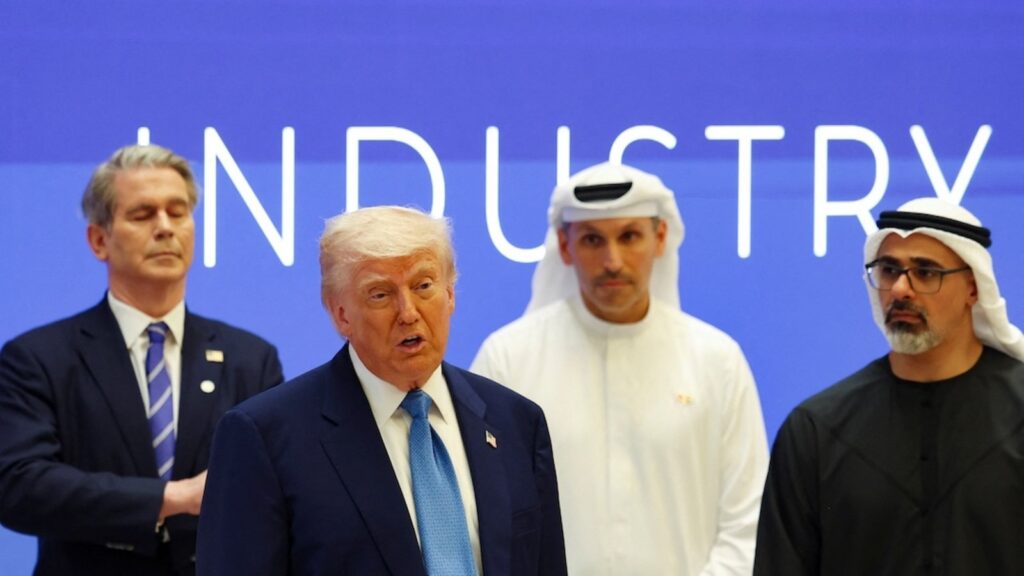
United Arab Emirates (UAE): Trillion-dollar outlook and high-tech focus
Wrapping up in Abu Dhabi (May 15–16), Trump landed several transformative deals. The UAE pledged $1.4 trillion in investment over the next decade to the United States. Included in these were $200 billion in new commercial deals, such as a $14.5 billion order from Etihad Airways for Boeing 787/777X aircraft, a $4 billion aluminum smelter project in Oklahoma by Emirates Global Aluminum, and $60 billion in energy production investments involving ExxonMobil and others.
Agreements also spanned AI, data infrastructure, semiconductors, cloud technology, and cybersecurity. The U.S.–UAE partnership extended into strategic domains, including a new AI center and regulatory cooperation.
Reality Check: Are the trillions real?
While headlines touted over $2 trillion in Gulf deals for the U.S., Reuters analysis pegs the concrete value closer to $730 billion, noting many deals were non-binding memorandums of understanding. Even so, confirmed contracts—like the Boeing order—did boost U.S. markets and represent tangible commitments.
Why it matters—for America and the Gulf
Economic and employment impact
Manufacturing, aerospace, energy, and defense sectors stand to gain U.S. jobs from Boeing, Aramco, ExxonMobil, and others. Infrastructure and AI investments could spark long-term growth.
Strategic and geopolitical significance
The deals reinforce U.S. ties with key Gulf allies amid global uncertainty. They advance U.S. interests in technology, defense capability, and energy diversification while offering Gulf nations leverage amid shifting global power dynamics.
Potential concerns and criticisms
Overstated figures are a concern, as many announced deals may not materialize as binding contracts. Critics also highlight conflicts of interest, pointing to Trump’s family business connections in the Gulf, such as golf resorts and real estate, which raise ethical questions. His acceptance of a luxury jet gift from Qatar sparked debate over the U.S. Constitution’s emoluments clause. Long-term success depends on sustained commitment and oversight.
Summary of Trump Gulf visit business deals
| Country | Key Highlights | Estimated Deal Value |
|---|---|---|
| Saudi Arabia | $142B arms deal; AI centers; infrastructure; tech firms involved | Part of $600B investment |
| Qatar | Largest Boeing jet order; future defense pledges | ~$96B aircraft; ~$38B defense |
| UAE | AI center, smelter, aircraft, infrastructure, energy & tech | $1.4T pledge; $200B new deals |
| Total | Gigantic headlines vs. real commitment | ~$2T claimed; ~$730B real |
Conclusion
Trump Gulf visit business deals offered a spectacular showcase of U.S.–Gulf economic diplomacy, with multibillion-dollar pledges and high-profile signings across three nations. The headline numbers signal ambition—but analysts caution that many remain aspirational. Still, the confirmed deals—aircraft orders, arms contracts, and infrastructure projects—highlight tangible opportunities. Whether these deals will deliver lasting economic growth, political benefit, and job creation depends on follow-through and transparency. For now, the tour stands as a bold reminder of the transactional power of diplomacy in the modern era.
Read More: Luxury Stocks Gap Widens: 7 Brands Winning or Losing Big

