

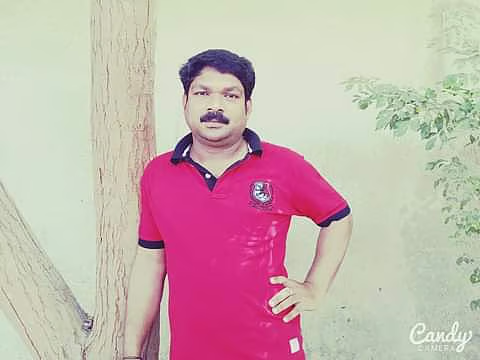
The case of the Indian expat’s body repatriated three months after death in UAE shines a light on the human stories behind migration, loss and the power of community. A 42-year-old Indian man from Kerala, who collapsed in the UAE and died, was declared missing by his family who believed he had been jailed. Instead, his body lay unclaimed in Sharjah for over three months before being sent home.
That phrase — Indian expat’s body repatriated three months after death in UAE — reflects both the tragedy and the resolution of a story that spanned continents, confusion, and hope. It holds the focus of this article: the journey of the body, the family’s ordeal, the community’s intervention, and the human values that prevailed in the end.
Tragedy hidden in plain sight: the missing brother
When the family last heard from the man on July 7, he seemed fine. The next communication stopped. In the weeks that followed, his sister in Kerala was told he had been arrested for a traffic offence. She believed her brother was in jail, and every call she made seemed unanswered.
Only on October 24 did volunteers and legal advocates discover he had collapsed on a roadside in Sharjah on July 14, been rushed to hospital and died that same day — but the body remained unclaimed in a forensic department. This is the heart of the story of the Indian expat’s body repatriated three months after death in UAE.
In those months of silence, the family grieved not knowing the truth — trusting that their brother would phone home. The mis-information, the assumption of imprisonment, the absence of a clear answer: all of it compounded the pain. And the man being away, on a visit visa and vulnerable, made everything more fragile.
The image of a missing brother, presumed alive but detained, only to find out later that he had died and his body had been waiting for months — that is the human anguish behind the headline.
The power of community: stepping in when institutions falter
The turning point in the case of the Indian expat’s body repatriated three months after death in UAE came when a community volunteer heard of the missing man and initiated the search. Social‐workers in Sharjah, legal consultants, and the man’s sister coordinated via WhatsApp; investigations uncovered the hospital records and mortuary data; and only then did authorities act.
Because of regulation, had the body remained unclaimed beyond three months it was scheduled for burial locally — something the family back home never wanted. Legal permissions were obtained, proof of relationship secured, and the repatriation was arranged.
This part of the story underlines that while systems may lag, human networks can step in. It reminds us that behind every statistical migration case or headline there is a real person, with family, stories and hopes — and that community can restore dignity.
Facing reality: reasons and lessons from the ordeal
Reflecting on the story of the Indian expat’s body repatriated three months after death in UAE, several realities emerge:
- Vulnerability of workers on visit visas or informal contracts. The man had shifted between jobs, had been duped in a recruitment scam and was on a visit visa when he died. Without formal employer support, his case fell through cracks.
- Information gaps across borders. The family assumed incarceration; they weren’t told he had collapsed, died, and his body was unclaimed. This truth lag shows how difficult communication can be for migrant families.
- Procedural hurdles in repatriation. Repatriating mortal remains involves legal, consular and logistical steps; when delays occur, the risk of local burial or further complications rises.
- The role of good-will actors. Volunteers, associations and legal consultants made the difference here, showing the value of local knowledge, care and persistence.
Through this story, the focus keyword—Indian expat’s body repatriated three months after death in UAE—serves as a reminder: the human journey doesn’t end at death; there is still dignity to protect, and a family waiting.
Towards hope: dignity reclaimed and lessons for all
When the body of the Indian expat was finally flown back to Thiruvananthapuram, with support from his family, community and government bodies, it marked more than just closure. It was the reclaiming of dignity. The man’s last rites could be performed by his loved ones; the silence was broken; the misunderstanding addressed.
For other expatriates and their families, this case offers hope and lessons:
- Keep contact channels open. If a migrant goes silent, pursue proactively rather than assume the worst.
- Be aware of visa status, employment status and rights to support — early documentation helps in eventualities.
- Know the mechanisms for repatriation of remains: who to call, what documents, what community support exists.
- Recognise that even in tragedy, community and compassion make the difference.
Because in the end, the phrase Indian expat’s body repatriated three months after death in UAE is more than a headline. It is a story of a man, his family’s pain and perseverance, and a community’s resolve to ensure that even in death, a human being is remembered, honoured and brought home.
Final thoughts
The story of the Indian expat’s body repatriated three months after death in UAE is heartbreaking but hopeful. It speaks to migration’s highs and lows, to systems and their gaps, and to the enduring human desire for connection, resolution and respect. It reminds us that every migrant’s journey continues in ways both seen and unseen—and that sometimes, it takes a village to make things right.
For the family, this has been a moment of grief, confusion and finally relief. For the broader community, it is a moment of learning: of how to support one another, how to shine light into the shadows, how to act so that no one is left unaccounted for. And for us as readers, it is an invitation to remember that behind every statistic, headline or news item, there is a life, a network of people, and a story — and honouring that story is the first step towards our shared humanity.
Do follow us: Instagram
Read More: Gulf Nations Commit $100 Billion to Renewable Energy, Aiming for 20% Emission Reduction by 2030

