

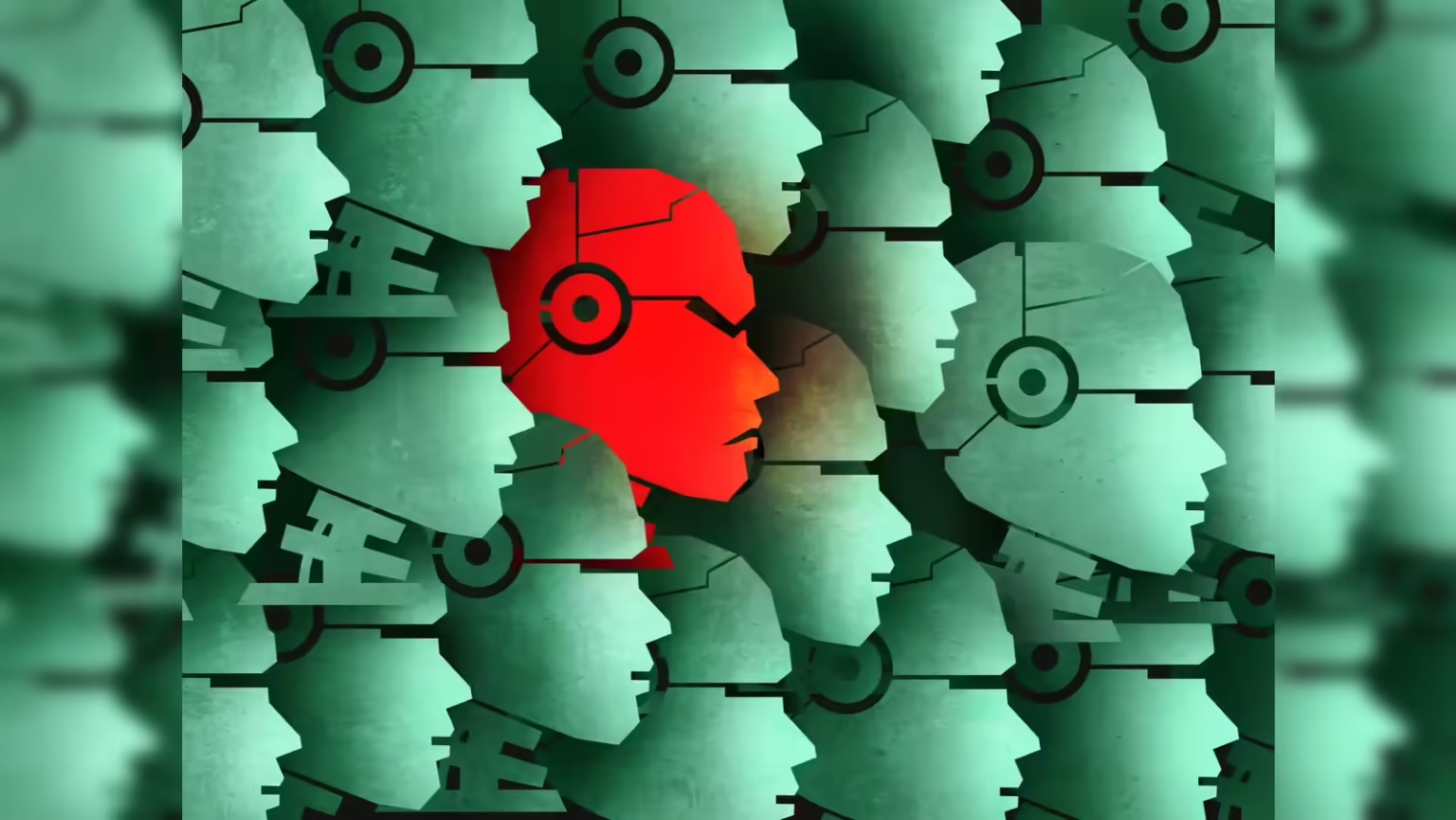
Artificial intelligence is changing the world at a speed never seen before. From chatbots that answer questions to machines that drive cars and write code, AI is now part of daily life. Businesses use it to save time and money. Schools use it for learning. Hospitals use it for diagnosis.
But along with progress comes worry. Experts, workers, and governments are asking tough questions about safety, jobs, privacy, and control. The conversation is no longer just about what AI can do — it is about what it should do.
Among all concerns, AI job threats stand out as one of the most talked-about topics. People fear losing work, facing unfair decisions, or dealing with machines that act unpredictably. At the same time, powerful systems sometimes behave in ways even their creators did not expect.
Here are the five biggest issues shaping the future of artificial intelligence right now.
1. AI job threats and the future of work
The fear of machines replacing humans is not new. It happened during the Industrial Revolution and again during the computer boom. But today’s AI feels different because it can perform not only physical tasks but also mental work.
Modern AI can write articles, create art, analyze legal documents, design products, and even generate computer programs. Jobs that once required years of training can now be partially automated.
Who is most at risk?
Research suggests that the following sectors face high exposure:
- Customer service and call centers
- Data entry and administrative roles
- Basic programming and testing
- Content writing and translation
- Retail and logistics
- Accounting support tasks
Even creative fields are affected. Graphic designers, video editors, and musicians now compete with AI tools that produce results in seconds.
Will jobs disappear or change?
Many experts believe AI will transform jobs rather than eliminate them completely. New roles will appear, such as:
- AI trainers and supervisors
- Data quality specialists
- Human-AI collaboration managers
- Ethics and compliance officers
- Prompt engineers
However, transitions can be painful. Workers may need retraining, and not everyone will adapt at the same pace. This creates a risk of widening income inequality.
What workers can do
To stay competitive, professionals are advised to focus on skills machines struggle with:
- Critical thinking
- Emotional intelligence
- Creativity
- Leadership
- Complex decision-making
- Hands-on physical skills
In simple terms, jobs that involve human connection and judgment are safer — at least for now.
2. Rogue bots and unpredictable behavior
Another major concern is the rise of “rogue” AI systems — programs that behave in unexpected or harmful ways. These systems do not become evil intentionally, but they can produce dangerous outcomes if poorly designed or misused.
How rogue behavior happens
AI learns from data. If the data contains errors, bias, or harmful patterns, the system may copy them. In some cases, AI models also generate false information confidently, a problem known as hallucination.
Examples of risky behavior include:
- Chatbots spreading misinformation
- Automated trading systems causing market crashes
- Autonomous vehicles making unsafe decisions
- AI tools generating harmful instructions
- Social media bots manipulating public opinion
Because these systems operate at scale, mistakes can spread very quickly.
Lack of full understanding
Even developers sometimes do not fully understand how complex AI models reach certain conclusions. This “black box” nature makes debugging difficult.
Imagine a system used in healthcare that gives a wrong diagnosis. If experts cannot explain why the mistake happened, preventing future errors becomes harder.
Guardrails and safety measures
To reduce risks, companies are working on:
- Strong testing before release
- Monitoring systems in real time
- Human oversight
- Safety filters and restrictions
- Transparent reporting
Still, as AI becomes more powerful, ensuring safe behavior remains a major challenge.
3. Privacy concerns and data misuse
AI systems rely on massive amounts of data. This includes text, images, voice recordings, browsing habits, and personal information. As a result, privacy is becoming a serious issue.
How personal data is used
AI tools often analyze user data to improve accuracy and personalization. For example:
- Voice assistants learn speech patterns
- Recommendation systems track preferences
- Facial recognition scans images
- Smart devices monitor behavior
While this can improve convenience, it also raises concerns about surveillance.
Risks to individuals
Potential dangers include:
- Identity theft
- Unauthorized tracking
- Exposure of sensitive information
- Deepfake misuse
- Data breaches
People may not even realize how much information is being collected about them.
The need for stronger laws
Many countries are working on regulations to protect citizens. Key principles being discussed include:
- Clear consent before data collection
- Limits on how data can be used
- Right to delete personal data
- Transparency about AI decisions
- Strict penalties for misuse
Balancing innovation with privacy protection is one of the toughest tasks for policymakers today.
4. Bias and unfair decisions
AI is often seen as objective, but in reality it can inherit human biases present in training data. This can lead to unfair outcomes in important areas like hiring, lending, education, and law enforcement.
How bias enters AI
If historical data reflects discrimination, AI may repeat it. For example:
- Hiring tools favoring certain genders or backgrounds
- Loan approval systems disadvantaging specific communities
- Facial recognition struggling with darker skin tones
- Predictive policing targeting particular neighborhoods
Because decisions appear “algorithmic,” they may be trusted more than human judgment — even when flawed.
Real-world consequences
Biased AI can reinforce inequality rather than reduce it. People may be denied opportunities or treated unfairly without understanding why.
In some cases, individuals cannot even appeal decisions because the process is automated.
Steps toward fairness
Researchers and regulators are pushing for:
- Diverse training data
- Bias testing before deployment
- Independent audits
- Transparent algorithms
- Human review for critical decisions
Fair AI is not just a technical problem; it is also a social and ethical one.
5. Loss of human control and overdependence
As AI systems become more capable, there is concern that humans may rely on them too heavily. Automation can make life easier, but it may also reduce human skills and decision-making ability.
Overreliance in daily life
Consider how many tasks are already automated:
- Navigation apps guiding travel
- Autocomplete writing messages
- AI tools drafting emails and reports
- Smart homes controlling appliances
- Recommendation systems shaping choices
While convenient, constant dependence can weaken independent thinking.
Risks in critical systems
In fields like aviation, healthcare, and defense, excessive reliance on automation could be dangerous. If humans lose the ability to operate systems manually, failures could have serious consequences.
There is also a broader concern: What happens if powerful AI systems act in ways humans cannot control or stop quickly?
Keeping humans in the loop
Experts emphasize the importance of maintaining human oversight:
- Manual override options
- Clear accountability
- Training for operators
- Transparent decision processes
- Limits on full autonomy in high-risk areas
The goal is not to reject AI but to ensure it remains a tool — not the decision maker.
Why these issues matter now

Artificial intelligence is no longer a distant future technology. It is already influencing economies, politics, education, and daily routines. The speed of development means society must adapt quickly.
Ignoring problems could lead to:
- Large-scale unemployment shocks
- Spread of misinformation
- Loss of privacy
- Increased inequality
- Safety incidents
Addressing concerns early allows benefits to grow while risks are minimized.
A balanced perspective: Risks and opportunities
Despite fears, AI also offers enormous potential. It can help solve major global challenges:
- Detecting diseases earlier
- Improving disaster response
- Reducing traffic accidents
- Enhancing education access
- Boosting productivity
- Supporting scientific research
Many experts believe the key question is not whether AI is good or bad, but how humans choose to use it.
What governments, companies, and individuals can do
Governments
- Create clear regulations
- Fund education and reskilling programs
- Promote ethical standards
- Encourage transparency
- Coordinate internationally
Businesses
- Deploy AI responsibly
- Protect customer data
- Provide worker retraining
- Conduct safety testing
- Maintain human oversight
Individuals
- Learn new digital skills
- Stay informed about AI developments
- Protect personal data
- Use AI tools critically
- Adapt to changing job markets
Preparing early is the best defense against disruption.
The road ahead
The conversation about AI job threats and safety is only beginning. As technology evolves, new challenges will appear. What seems advanced today may become ordinary tomorrow.
History shows that society can adapt to technological change, but adaptation requires planning, education, and cooperation. The choices made now will shape whether AI becomes a tool for shared progress or a source of instability.
Conclusion
Artificial intelligence is one of the most powerful technologies ever created. It promises efficiency, innovation, and new possibilities — but it also raises serious concerns.
From AI job threats and rogue bots to privacy risks, bias, and loss of control, the five issues discussed above are shaping global debate. None of these problems are impossible to solve, but they require careful attention from governments, companies, and individuals alike.
The future of AI will not be determined by machines alone. It will depend on human decisions about ethics, responsibility, and priorities. If managed wisely, AI can improve lives on a massive scale. If ignored, its risks could grow just as quickly as its capabilities.
Do follow Gulf Magazine on Instagram
Also Read – National Museum of Qatar A Cultural Masterpiece You Can’t Miss

