

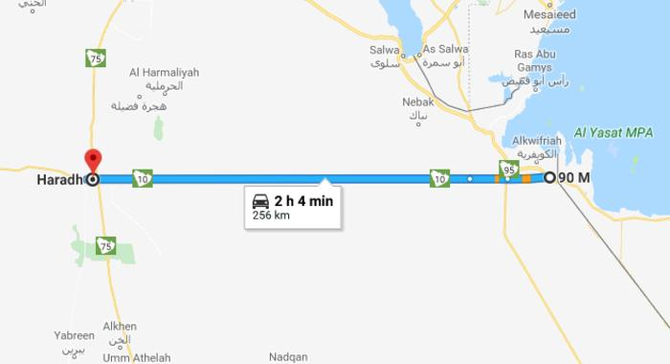
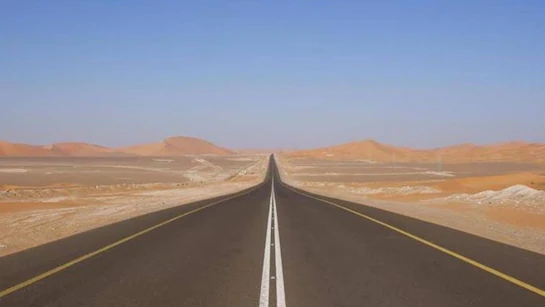
Longest Straight Road the vast desert landscape of Saudi Arabia lies a stretch of road that defies the norms of highway engineering. Known as Highway 10, this extraordinary route holds the title of the longest straight road in the world, stretching a jaw-dropping 256 kilometers without a single bend, curve, or deviation.
While it might sound simple, designing and building such a road is a major feat of engineering. It runs through one of the most extreme environments on the planet—the Rub’ al Khali desert, also called the Empty Quarter, one of the largest continuous sand deserts in the world.
This record-breaking segment of Highway 10 begins near the town of Haradh and continues all the way to Al Batha, which lies close to the border with the United Arab Emirates. What makes this road so remarkable is not just its length, but the fact that it is completely straight from beginning to end, offering drivers an uninterrupted path for nearly two full hours of driving.
A Road with No Turns – Literally
Imagine driving for over 250 kilometers without ever needing to touch the steering wheel to turn. That’s what this stretch of Highway 10 offers. The road is so straight and so flat that it almost feels like you’re driving on a ruler laid across the desert.
Originally, this road was not intended for public use. It was constructed as a private route for King Fahd, a former ruler of Saudi Arabia, to travel swiftly across the desert. Later, the road was made available for public use, and since then, it has fascinated both locals and international travelers.
Before Saudi Arabia’s Highway 10 claimed the top spot, Australia’s Eyre Highway held the record with a straight stretch of 146 kilometers. But Highway 10 not only beat that record—it nearly doubled it, putting the Saudi highway in a league of its own.
Engineering a Straight Path Across the Desert
Building a road of this kind requires precise planning and a deep understanding of geography, climate, and logistics. The harsh desert environment offers many challenges, including extreme temperatures, shifting sands, and a lack of nearby infrastructure.
The Rub’ al Khali desert is one of the most remote and least populated areas in the world. There are few towns, no major cities along this stretch, and very little vegetation. The terrain is largely flat, which helped engineers keep the road perfectly level and straight.
To achieve this, massive earth-moving equipment was used to flatten and compact the land. Asphalt was laid over reinforced sub-layers to withstand the harsh climate and avoid damage from sand movement. The construction had to factor in sandstorms, heat expansion, and even camel crossings, as these animals are common in the region and can be a hazard to motorists.
An Unusual Driving Experience
Driving on this road is unlike anything most people have ever experienced. The endless, unchanging landscape can be both hypnotic and surreal. It may sound peaceful, but it can be dangerous if drivers aren’t careful.
One of the biggest risks is driver fatigue. With no curves or visual variation, it’s easy for drivers to become drowsy or lose focus. This is why experts strongly recommend that anyone traveling this road take regular breaks, stay hydrated, and avoid driving at night if possible.
Despite its simplicity, accidents do happen—mainly due to speed, distraction, or wildlife suddenly crossing the highway. Drivers also need to be self-sufficient, as fuel stations, rest stops, and help services are very limited along this route. Breaking down in the middle of the Empty Quarter can be dangerous if you’re not prepared.
Still, for those up for the challenge, it’s a road trip like no other. It’s a test of both the vehicle and the driver, offering a unique experience in one of the most isolated environments on Earth.
More Than Just a Road – A Symbol of Saudi Progress
Highway 10 is part of Saudi Arabia’s larger national infrastructure plan, which aims to improve transportation and connectivity across the kingdom. The total length of the highway is approximately 1,480 kilometers, making it a key link between the Red Sea coast and the eastern border with the United Arab Emirates.
The development of this road aligns with Saudi Arabia’s Vision 2030—a major national project to diversify the country’s economy and improve public infrastructure. The government is investing heavily in transportation, tourism, and logistics, with the goal of making Saudi Arabia a regional hub for trade and travel.
In this light, Highway 10 is more than just an engineering marvel—it represents the ambition and innovation of a nation looking to the future. It’s also a clear signal to the world that Saudi Arabia is serious about modernizing and opening up new opportunities for business and exploration.
What Travelers Should Know Before Visiting
If you’re planning to travel along Highway 10, there are a few things to keep in mind:
- Prepare your vehicle: Make sure your car is in excellent condition. Carry extra fuel, water, and food, as there are few services available.
- Stay alert: The monotony of the drive can make you sleepy. Switch drivers if possible and take breaks often.
- Watch for wildlife: Camels and other animals may wander onto the road unexpectedly, especially at night.
- Check weather conditions: Sandstorms are common and can reduce visibility dramatically.
Many adventurous travelers and YouTubers have already driven along Highway 10 and shared their experiences. The road has quickly become a bucket-list destination for road trip lovers and driving enthusiasts.
Conclusion
Saudi Arabia’s Highway 10 isn’t just a long road—it’s a world record-holding achievement that captures the spirit of innovation and progress. Stretching 256 kilometers without a single turn, it’s a route that challenges perceptions of what a highway can be.
Whether you’re an engineer amazed by its design, a traveler drawn to remote experiences, or simply someone fascinated by world records, this incredible road through the desert is worth knowing about. It’s not just the longest straight road on Earth—it might also be one of the most unforgettable.

