

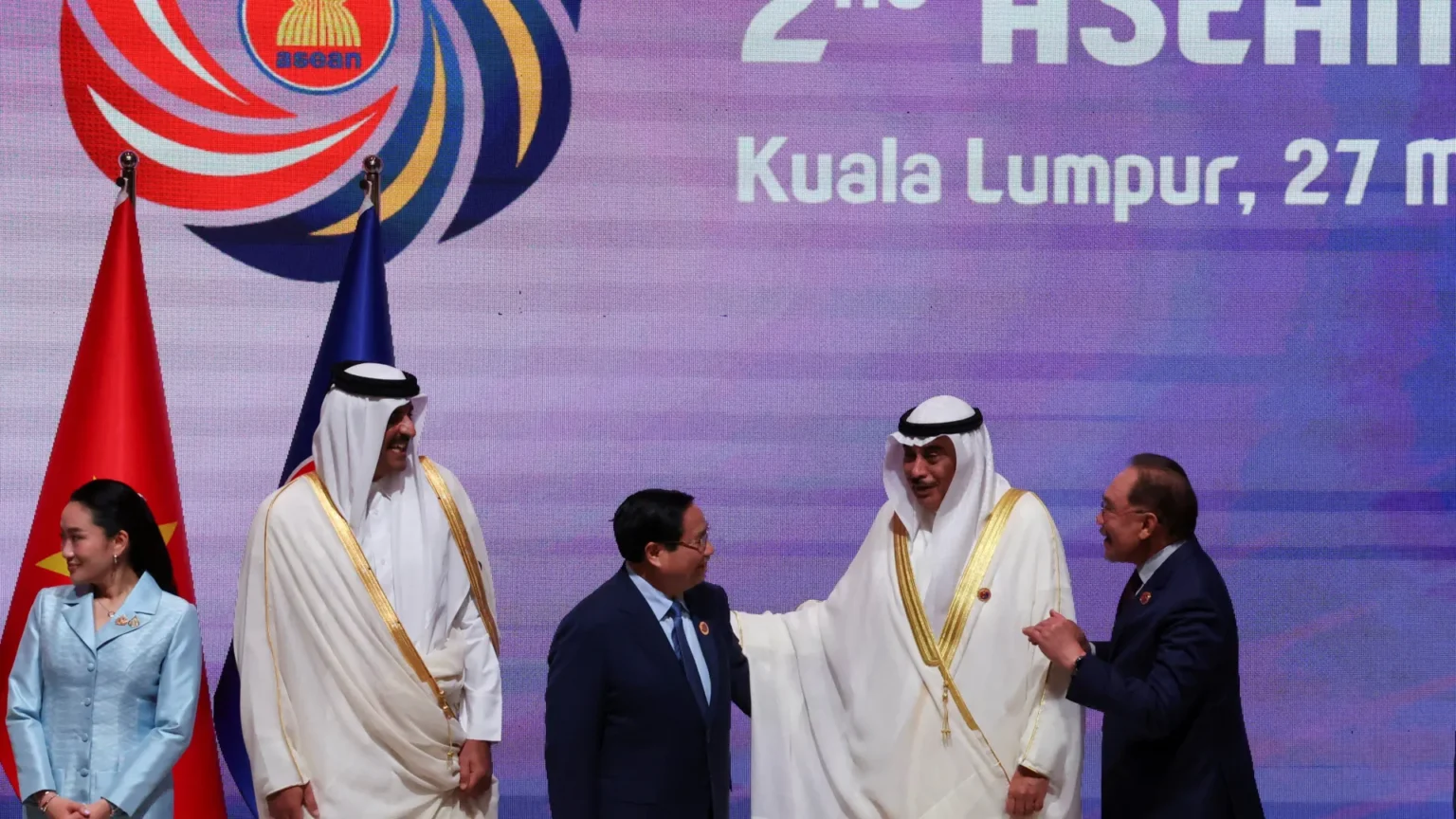
ASEAN China Gulf summit amid US tariffs marks a turning point for Southeast Asia as the region seeks resilience and stability in the face of growing trade tensions. The Association of Southeast Asian Nations (ASEAN) has begun high-level meetings with China and Gulf states, aiming to secure economic partnerships while navigating the challenges of US protectionist policies.
Introduction: A Trilateral First
On May 27, 2025, in Kuala Lumpur, ASEAN launched its first-ever three-way summit involving China and the Gulf Cooperation Council (GCC). The meeting comes amid growing concerns over US-imposed tariffs that threaten to disrupt Southeast Asia’s export-driven economies. This landmark summit marks a critical step in ASEAN’s strategy to diversify economic partnerships and cushion the impact of global protectionism.
Why the Summit Matters: Building Economic Resilience
The summit takes place against a backdrop of serious trade disruption. Several ASEAN members are facing tariffs ranging from 32% to 49% from the United States, significantly impacting their export-oriented industries. Malaysia’s Prime Minister Anwar Ibrahim, who currently chairs ASEAN, opened the meeting by urging unity and resilience as protectionism rises.

Strategic Interests of Key Players
ASEAN’s main goal is to protect member economies and preserve multilateralism in the face of unilateral pressures. Prime Minister Anwar emphasized that bilateral agreements with the US should not harm other ASEAN members.
China’s Premier Li Qiang highlighted the importance of open regionalism and joint cooperation, offering China as a reliable economic partner amidst global uncertainty.
The GCC, comprising Bahrain, Kuwait, Oman, Qatar, Saudi Arabia, and the UAE, seeks to deepen ties with ASEAN and capture trade and investment opportunities in Asia.
Together, ASEAN, China, and the Gulf represent nearly 25 trillion dollars in GDP and more than 2 billion people, giving this trilateral partnership enormous potential to drive cross-regional growth.
Outcomes: Agreements and Commitments
ASEAN, the GCC, and China pledged to strengthen free trade, accelerate the long-discussed GCC-China Free Trade Agreement, and upgrade the ASEAN-China Free Trade Area.
A joint statement reaffirmed a shared goal to unlock the full potential of this trilateral partnership in ways that bring tangible benefits to ordinary citizens.
ASEAN’s Navigation Between Powers
ASEAN continues to follow a policy of neutrality, avoiding choosing sides between the United States and China. Instead, the bloc is building practical economic buffers.
Malaysian Foreign Minister Mohamad Hasan urged ASEAN to strengthen internal ties, diversify markets, and act collectively in response to tariffs. Analysts see the summit as a pragmatic move, allowing ASEAN to prepare for volatility without alienating either major power.
The US and ASEAN: A Delicate Balance
Despite diversification efforts, the United States remains ASEAN’s largest export market and the leading source of foreign investment, with nearly 480 billion dollars in stock by 2024.
US Secretary of State Marco Rubio visited the region in July to reassure partners of America’s Indo-Pacific commitment. But doubts persist, as President Trump’s tariff policies push ASEAN toward more predictable partnerships with China and the Gulf.
Broader Geopolitical Implications
At the 2025 Shangri-La Dialogue, US officials pressed for security and defense cooperation. ASEAN leaders, however, stressed that economic stability is equally vital and should not be tied to defense commitments.
Some ASEAN members face tariffs as high as 40 percent, which could significantly slow growth. Thailand, for example, risks GDP growth falling below 1 percent if tariffs remain.
What Lies Ahead? Challenges and Opportunities
Opportunities include deeper trade, investment, and diversification with China and Gulf states. Enhanced trilateral cooperation may pave the way for new free trade agreements and integrated supply chains.
Challenges remain. ASEAN must carefully balance relations with both the US and China, avoiding over-dependence on either. Coordinating agreements that serve all ten members fairly is not easy, and internal issues such as Myanmar continue to complicate ASEAN’s ability to act as a united bloc.
Conclusion: Steering Toward Economic Stability
The ASEAN China Gulf summit amid US tariffs is a bold, pragmatic step by Southeast Asian nations toward greater regional resilience. By aligning more closely with China and the Gulf, ASEAN is seeking to shield its economies from unpredictable protectionist policies while keeping its long-standing neutrality intact.
As global tensions grow, ASEAN’s unity, flexibility, and balanced diplomacy will be more important than ever in shaping its economic future.
Read More: Saudi Arabia Tightens Work Visa Rules for Indian Workers

