

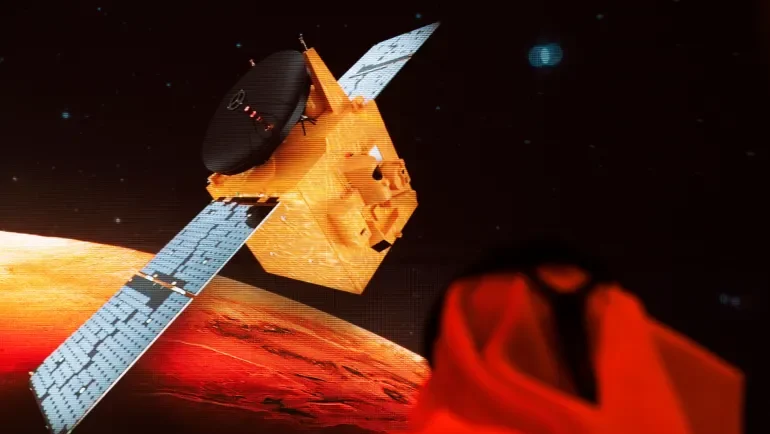
Gulf Nations Set Sights on Mars and Beyond
The Arab world has embarked on an ambitious journey into space exploration, marking a significant milestone with the United Arab Emirates’ (UAE) successful Mars mission. This endeavor not only showcases the region’s technological prowess but also sets the stage for future interplanetary aspirations.
UAE’s Historic Mars Mission
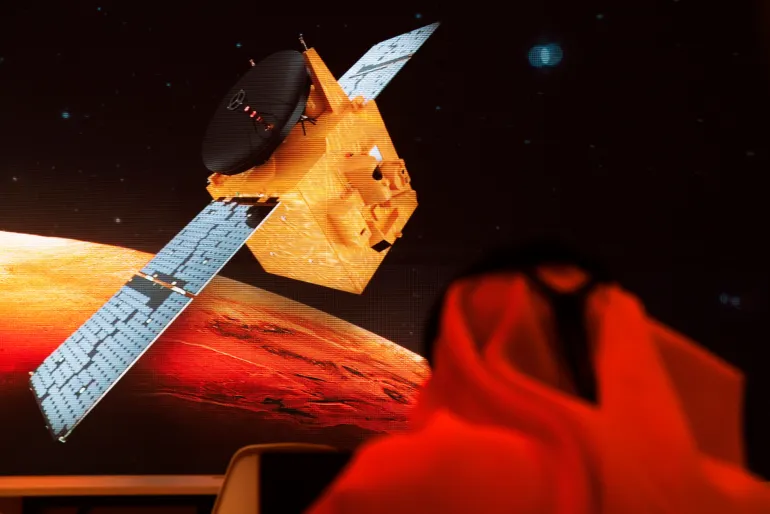
In a landmark achievement, the UAE’s Hope probe entered Mars’ orbit on February 9, 2021, making the UAE the fifth entity to reach the Red Planet, joining the ranks of NASA, the Soviet Union, the European Space Agency, and India.
The probe’s primary objectives include:
- Investigating the connection between current Martian weather and the planet’s ancient climate.
- Studying mechanisms driving the loss of hydrogen and oxygen from Mars’ atmosphere.
- Examining interactions between the lower and upper atmosphere.
- Providing a comprehensive view of the Martian climate across different times and seasons.
This mission represents a significant leap for the UAE, transitioning from limited experience in spacecraft design to executing a complex interplanetary endeavor. Collaborations with American universities facilitated knowledge transfer, enabling Emirati engineers to develop the sophisticated probe in just six years.
Regional Impact and Future Aspirations
The success of the Hope probe has resonated throughout the Arab world, inspiring a renewed focus on space exploration. Landmarks across the region, including Dubai’s Burj Khalifa, illuminated in red to celebrate the achievement.
This mission aligns with the UAE’s broader vision to diversify its economy beyond oil and gas, fostering a knowledge-based economy driven by scientific research and technological innovation. The data collected by the Hope probe is expected to contribute significantly to global understanding of Mars’ atmosphere and climate.
Collaborative Efforts and Knowledge Transfer
The UAE’s approach to the Mars mission emphasized building domestic capabilities through international partnerships. Emirati engineers worked alongside experts from institutions like the University of Colorado Boulder, University of California, Berkeley, and Arizona State University. This collaboration ensured that the UAE could undertake future missions independently, leveraging the expertise gained during the Hope project.
Challenges and Triumphs
The journey to Mars was fraught with challenges, including the critical Mars Orbit Insertion maneuver. This 27-minute thruster burn was executed autonomously, with mission control awaiting confirmation due to a communication delay. The successful completion of this maneuver was a testament to the meticulous planning and expertise of the mission team.
Inspiring the Next Generation
Beyond technological achievements, the Hope mission serves as an inspiration for the youth in the UAE and the broader Arab region. It symbolizes the possibilities that arise from ambition, collaboration, and dedication to scientific advancement.
Conclusion
The UAE’s Mars mission marks a pivotal moment in the Gulf’s space ambitions, demonstrating the region’s commitment to contributing meaningfully to global space exploration efforts. As the Arab world sets its sights on Mars and beyond, the success
Do follow gulf magazine on Instagram

