

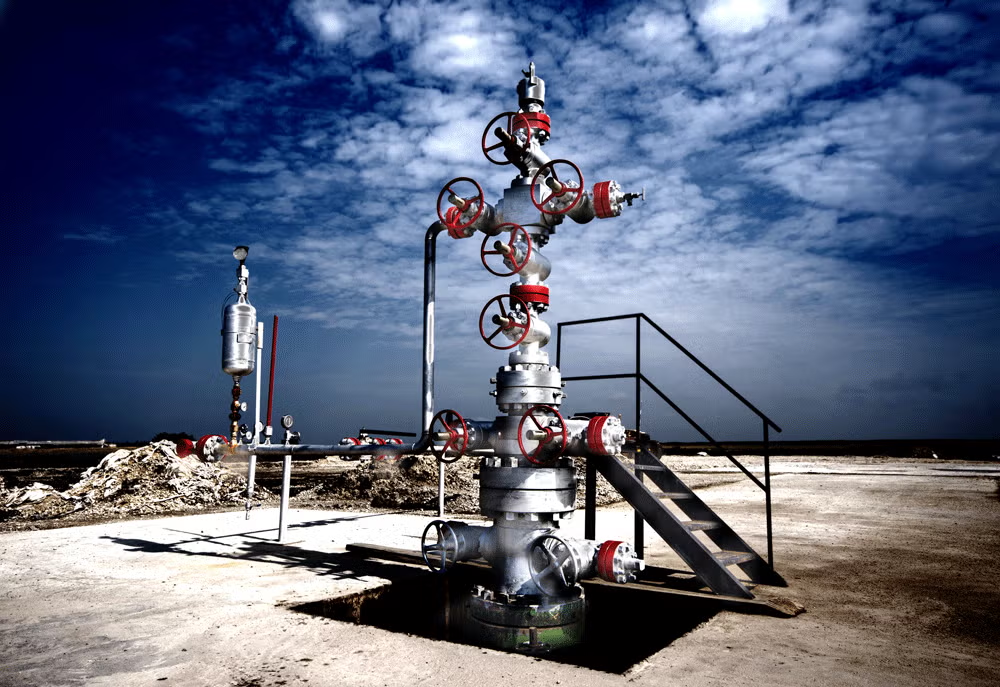
The Halliburton Saudi Arabia Kuwait Oil & Gas 2026 landscape shows how advanced technology is reshaping energy production across the Middle East. As global demand for oil and gas remains strong, countries like Saudi Arabia and Kuwait are investing heavily in innovation to maintain their leadership in the energy sector. A key player in this transformation is Halliburton Company, one of the world’s largest providers of oilfield services and technologies.
From artificial intelligence and digital drilling systems to carbon reduction solutions and smart reservoirs, Halliburton’s work in the Gulf region is helping shape what the energy industry may look like by 2026 and beyond. This article explores how advanced technologies, strategic partnerships, and sustainability initiatives are driving a new era for oil and gas in the Middle East.
The Strategic Importance of Saudi Arabia and Kuwait
The Middle East holds some of the largest proven oil reserves in the world. Saudi Arabia alone accounts for a major share of global supply, while Kuwait continues to be a crucial exporter with significant reserves and production capacity.
Both nations are pursuing long-term economic strategies that balance continued hydrocarbon leadership with diversification.
Key national priorities include:
- Maintaining stable oil production
- Increasing efficiency through technology
- Reducing environmental impact
- Developing local expertise and industries
- Supporting energy security worldwide
In Saudi Arabia, Vision 2030 emphasizes economic diversification and advanced industry development. Kuwait’s national plans similarly focus on modernization, infrastructure upgrades, and sustainable growth.
Halliburton’s presence in both countries aligns closely with these goals, making the Halliburton Saudi Arabia Kuwait Oil & Gas 2026 outlook particularly significant.
Halliburton’s Expanding Role in the Gulf Energy Sector
Halliburton has operated in the Middle East for decades, providing services across exploration, drilling, completion, and production. In recent years, the company has increased investments in technology centers, local manufacturing, and workforce development.
Major areas of involvement include:
- Offshore and onshore drilling operations
- Hydraulic fracturing and stimulation
- Reservoir evaluation
- Digital oilfield solutions
- Production optimization
The company works closely with national oil firms, including Saudi Aramco and Kuwait Oil Company, to improve efficiency and maximize recovery from existing fields.
By 2026, analysts expect Halliburton’s regional operations to focus heavily on automation, data analytics, and environmentally responsible production methods.
Advanced Drilling Technologies Transforming Production
One of the biggest changes in the Halliburton Saudi Arabia Kuwait Oil & Gas 2026 landscape is the shift toward smart drilling systems.
Traditional drilling relied heavily on manual decision-making and reactive adjustments. Today, advanced systems allow real-time monitoring and automated control.
Key innovations include:
1. Digital Drilling Platforms
Sensors placed throughout drilling equipment collect data on pressure, temperature, vibration, and rock properties. Software analyzes this data instantly to guide operations.
2. Automated Directional Drilling
AI-powered tools can steer drill bits with high precision, allowing access to complex reservoirs while minimizing risk.
3. Remote Operations Centers
Engineers can monitor multiple wells from centralized facilities, reducing personnel requirements on rigs and improving safety.
4. Faster Well Construction
Optimized drilling paths and predictive analytics reduce time and cost per well.
These technologies allow oil producers in Saudi Arabia and Kuwait to extract resources more efficiently while lowering operational risks.
Smart Reservoir Management
Beyond drilling, managing reservoirs effectively is critical for long-term production.
Halliburton’s digital reservoir technologies help operators understand how oil, gas, and water move underground.
Benefits of smart reservoir systems:
- Improved recovery rates
- Reduced water production
- Better planning of future wells
- Longer field life
- Lower operating costs
Advanced modeling tools combine geological data, seismic information, and production history to create detailed simulations. Engineers can test different strategies virtually before applying them in the field.
For mature fields in Kuwait and Saudi Arabia, this approach is especially valuable, as maximizing output from existing assets is often more cost-effective than developing new ones.
Artificial Intelligence and Data Analytics
Artificial intelligence is becoming a core component of the oil and gas industry.
In the Halliburton Saudi Arabia Kuwait Oil & Gas 2026 environment, AI helps companies make faster and more accurate decisions.
Applications include:
- Predictive maintenance of equipment
- Automated drilling optimization
- Production forecasting
- Safety monitoring
- Supply chain management
For example, machine learning models can detect early signs of equipment failure, allowing repairs before costly breakdowns occur.
AI also helps reduce downtime — a major expense in large-scale energy operations.
Hydraulic Fracturing and Enhanced Recovery
Hydraulic fracturing (fracking) and enhanced oil recovery (EOR) techniques are essential for extracting resources from challenging reservoirs.
Halliburton has developed advanced methods that improve efficiency while reducing environmental impact.
Innovations include:
- High-performance fracturing fluids
- Precision placement technologies
- Real-time fracture monitoring
- Reduced water usage solutions
In Kuwait, heavy oil deposits require specialized techniques to extract efficiently. In Saudi Arabia, unconventional gas development is becoming increasingly important for domestic energy supply.
These technologies support both countries’ goals of meeting rising energy demand without excessive new exploration.
Sustainability and Environmental Responsibility
As climate concerns grow, oil and gas companies face pressure to reduce emissions and environmental impact.
Halliburton’s strategy in Saudi Arabia and Kuwait increasingly focuses on sustainability.
Key initiatives:
Carbon Reduction Technologies
Tools that minimize flaring, reduce methane emissions, and improve energy efficiency.
Water Management Solutions
Systems for recycling and treating water used in drilling and fracturing.
Lower-Emission Equipment
Electric and hybrid systems replacing diesel-powered machinery.
Carbon Capture Support
Technologies that enable capturing and storing CO₂ from industrial processes.
Both Saudi Arabia and Kuwait are investing in carbon management as part of their long-term energy strategies. These efforts aim to balance continued hydrocarbon production with environmental responsibility.
Localization and Workforce Development
Another important aspect of the Halliburton Saudi Arabia Kuwait Oil & Gas 2026 vision is building local capacity.
Governments in the region encourage international companies to:
- Hire and train local workers
- Establish research centers
- Support domestic industries
- Transfer technical knowledge
Halliburton has expanded training programs and partnerships with universities to develop skilled engineers and technicians.
Localization benefits include:
- Job creation
- Economic diversification
- Reduced reliance on foreign expertise
- Stronger national industries
This approach aligns with national development plans across the Gulf region.
Digital Transformation of Oilfields
The concept of the “digital oilfield” is becoming reality.
Instead of isolated operations, modern oilfields function as interconnected systems where data flows continuously between equipment, engineers, and management teams.
Features of digital oilfields:
- Internet of Things (IoT) sensors
- Cloud-based data platforms
- Real-time performance dashboards
- Automated control systems
- Remote inspections using drones and robotics
These technologies improve efficiency, safety, and decision-making.
For countries managing hundreds of wells across vast desert and offshore environments, digital integration is especially valuable.
Offshore Expansion and Deepwater Technology
While much production in Saudi Arabia and Kuwait is onshore, offshore projects remain significant.
Advanced offshore technologies include:
- Subsea production systems
- High-pressure drilling equipment
- Remote underwater monitoring
- Corrosion-resistant materials
Halliburton’s expertise in complex offshore environments supports long-term energy supply stability.
Economic Impact on the Region
Oil and gas remain central to the economies of both Saudi Arabia and Kuwait.
Technological advancements driven by companies like Halliburton help:
- Increase government revenues
- Support public services and infrastructure
- Stabilize global energy markets
- Attract foreign investment
- Encourage industrial growth
By improving efficiency, these technologies allow countries to maintain production levels even as easily accessible reserves decline.
Energy Security and Global Supply
The Middle East plays a crucial role in global energy security.
Stable production from Saudi Arabia and Kuwait helps balance international markets, particularly during periods of geopolitical uncertainty or supply disruptions elsewhere.
The Halliburton Saudi Arabia Kuwait Oil & Gas 2026 outlook suggests that advanced technology will enable consistent output while adapting to changing market conditions.
Challenges Facing the Industry
Despite technological progress, several challenges remain:
1. Volatile Oil Prices
Market fluctuations affect investment decisions and project timelines.
2. Energy Transition Pressures
Global efforts to shift toward renewable energy create uncertainty about long-term demand.
3. Environmental Regulations
Stricter rules require continuous innovation to reduce emissions.
4. Complex Reservoirs
Remaining resources are often harder to extract, requiring advanced techniques.
Halliburton’s technology-driven approach aims to address these challenges while maintaining profitability.
The Future Beyond 2026
Looking ahead, the oil and gas sector in Saudi Arabia and Kuwait is likely to evolve in several ways:
- Greater integration of AI and automation
- Expansion of natural gas production
- Increased focus on carbon management
- Hybrid energy systems combining fossil fuels and renewables
- Development of hydrogen and clean fuels
Halliburton’s role will likely expand beyond traditional services into broader energy solutions.
Conclusion
The Halliburton Saudi Arabia Kuwait Oil & Gas 2026 scenario illustrates how technology is transforming one of the world’s most important energy regions. Through digital innovation, advanced drilling methods, sustainability initiatives, and workforce development, Halliburton is helping Saudi Arabia and Kuwait maintain their leadership in global energy production while preparing for a more complex future.
As the world navigates the transition toward cleaner energy, oil and gas will remain essential for decades. The key challenge is producing these resources responsibly, efficiently, and safely.
With continued investment in technology and collaboration between governments and industry leaders, the Middle East is positioned not just to remain an energy powerhouse — but to redefine how hydrocarbons are produced in the 21st century.
The coming years will reveal how effectively these innovations balance economic growth, environmental responsibility, and global energy needs. If current trends continue, the region’s advanced oil and gas sector could serve as a model for energy development worldwide.
Do Follow Gulf Magazine on Instagram
Also read: Oman Expands Duqm Port: A Big Step for Trade and Growth

