

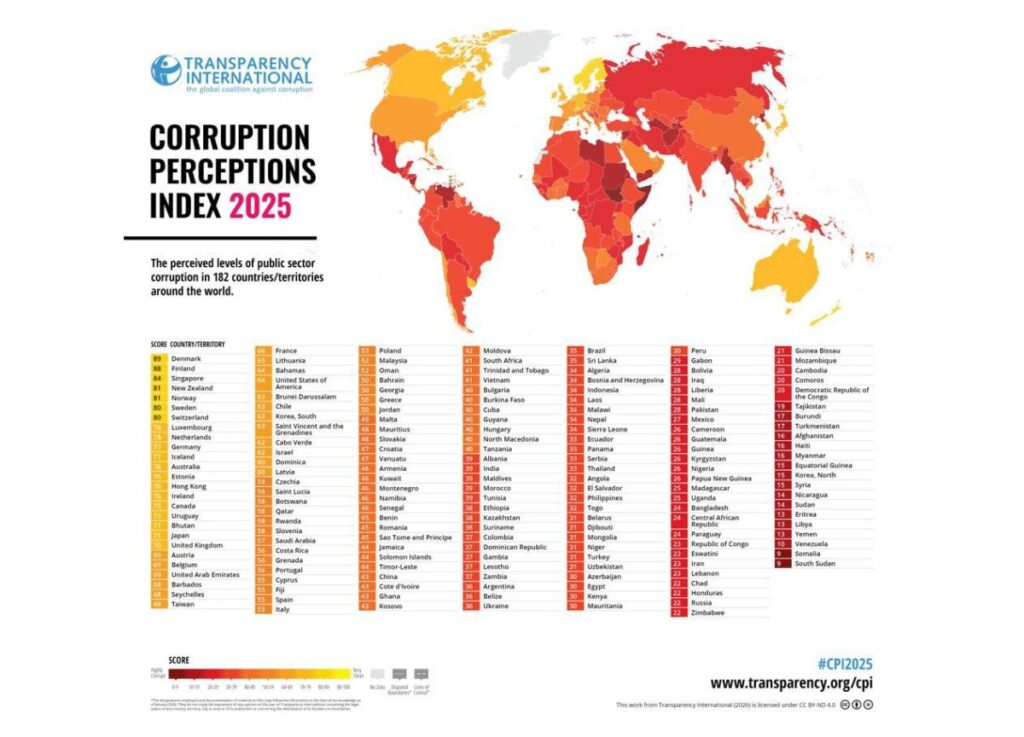
Kuwait Corruption Index Ranking has remained unchanged at 65th place in the latest global corruption perception report, reflecting continued governance challenges and steady but limited progress in transparency reforms. The ranking, released as part of the widely recognized Corruption Perceptions Index (CPI), measures how countries are perceived in terms of public sector corruption.
While Kuwait has not seen a drop in its position, it has also not made significant gains. For many observers, this steady placement signals a mixed picture. On one hand, the country has avoided decline. On the other, it has not yet achieved the improvements needed to climb higher in global rankings.
The Corruption Perceptions Index is published annually and evaluates countries based on expert assessments and opinion surveys. The index scores nations on a scale from 0 to 100, where 0 indicates highly corrupt and 100 indicates very clean. Rankings are then determined by comparing these scores globally.
Kuwait’s position at 65th places it in the middle range internationally. Within the Gulf region, however, it continues to trail behind some of its neighboring countries that have scored higher in recent years.
Understanding the Kuwait Corruption Index Ranking
The Kuwait Corruption Index Ranking reflects perceptions of corruption in the public sector. It considers factors such as bribery, misuse of public funds, lack of transparency in government decision-making, and the effectiveness of anti-corruption institutions.
It is important to note that the index does not measure actual corruption cases directly. Instead, it measures how corruption is perceived by business leaders, experts, and institutions. Perception matters because it affects investor confidence, public trust, and the overall image of a country.
Kuwait’s score has remained relatively stable in recent years. Stability can sometimes indicate consistency in governance structures, but it may also show that reforms have not yet been strong enough to bring noticeable change.
Experts often emphasize that maintaining a middle position is not enough for a country that aims to attract international investment and build a strong knowledge-based economy. Continuous improvement in transparency and accountability is essential for long-term growth.
Regional Comparison: How Kuwait Stands in the Gulf
When compared to other Gulf Cooperation Council (GCC) countries, Kuwait’s ranking shows room for improvement. Some neighboring countries have implemented aggressive anti-corruption reforms, digital government services, and stricter financial oversight systems, leading to higher scores.
In contrast, Kuwait has faced political tensions between the executive and legislative branches in recent years. Frequent parliamentary dissolutions and cabinet reshuffles have slowed down the implementation of structural reforms. Political instability often makes it harder to push forward comprehensive anti-corruption measures.
However, Kuwait still performs better than many countries globally. Its legal framework includes oversight institutions such as the Kuwait Anti-Corruption Authority (Nazaha), which was established to investigate corruption cases and promote transparency.
The key challenge lies not only in having laws and institutions but in ensuring they function effectively and independently.
Why the Kuwait Corruption Index Ranking Matters
The Kuwait Corruption Index Ranking has important implications for the country’s economy, governance, and global reputation.
- Investor Confidence
International investors often review corruption rankings before entering a new market. A stable or improving ranking increases confidence, while stagnation can raise concerns about regulatory risks. - Public Trust
Citizens expect accountability from public officials. A strong anti-corruption environment strengthens trust between the government and the people. - Economic Diversification
Kuwait is working to diversify its economy beyond oil. Transparent systems are critical to attracting foreign direct investment in sectors such as finance, technology, and tourism. - International Image
Global rankings shape how countries are perceived on the world stage. A higher ranking enhances credibility in international partnerships and agreements.
For Kuwait, remaining at 65th suggests that while major setbacks have been avoided, stronger reforms are needed to improve its global standing.
Government Efforts to Improve Transparency
In recent years, Kuwaiti authorities have taken several steps aimed at improving governance and reducing corruption.
Strengthening Oversight Bodies
The Kuwait Anti-Corruption Authority has been given broader powers to investigate financial crimes and require asset declarations from public officials. Efforts have also been made to enhance coordination between oversight agencies.
Digital Transformation
The government has introduced more digital services to reduce bureaucracy and limit opportunities for bribery. Online platforms for government transactions can increase transparency by minimizing direct contact between officials and citizens.
Legal Reforms
There have been discussions about updating procurement laws and financial regulations to close loopholes. Transparent bidding processes are essential in preventing misuse of public funds.
Despite these measures, experts say implementation remains the biggest challenge. Laws alone are not enough if enforcement mechanisms are weak or slow.
Challenges Facing Kuwait’s Anti-Corruption Drive
Several factors may explain why the Kuwait Corruption Index Ranking has not improved significantly.
Political Gridlock
Frequent political disputes have sometimes delayed reform initiatives. When legislative processes slow down, important anti-corruption measures may remain pending.
Public Sector Complexity
Kuwait has a large public sector workforce. Managing such a system requires strong oversight and modern management practices.
Cultural and Social Factors
In many countries, long-standing social networks and informal practices can complicate anti-corruption efforts. Addressing these issues requires long-term cultural change alongside legal reform.
Economic Pressures
Fluctuations in oil prices affect government revenues. During times of economic stress, transparency reforms may compete with other urgent priorities.
Public Reaction and Expert Opinions
Public response to the latest ranking has been mixed. Some see stability as a sign that Kuwait has avoided regression, especially in a region facing various political and economic challenges.
Others argue that maintaining the same rank year after year shows that progress is too slow. Civil society groups have called for stronger enforcement of anti-corruption laws and greater transparency in public spending.
Economic analysts point out that global competition for investment is increasing. Countries that move up in corruption rankings often benefit from improved business environments and lower borrowing costs.
Experts agree that improving the Kuwait Corruption Index Ranking requires consistent, long-term commitment rather than short-term initiatives.
The Road Ahead: What Needs to Change
If Kuwait aims to move higher in future rankings, several steps could make a difference.
Enhancing Institutional Independence
Oversight bodies must operate independently from political influence. Clear accountability frameworks help ensure fair investigations.
Faster Judicial Processes
Corruption cases should be resolved efficiently. Delays can weaken public confidence and reduce the deterrent effect.
Greater Public Access to Information
Transparency in government budgets, contracts, and spending builds trust. Open data initiatives can empower citizens and journalists.
Encouraging Whistleblower Protection
Individuals who report corruption must feel safe. Strong protection laws encourage accountability.
Education and Awareness
Anti-corruption values should be promoted through education and public campaigns. Long-term cultural change supports legal reforms.
Economic Impact of Corruption Perception
Perception of corruption can directly influence economic growth. When businesses believe that systems are transparent and fair, they are more willing to invest.
For Kuwait, which depends heavily on oil revenue, diversification is a key goal. Attracting international companies requires a business-friendly environment built on trust and clarity.
Studies have shown that countries with higher transparency rankings often experience stronger economic growth and more sustainable development.
Improving the Kuwait Corruption Index Ranking could therefore contribute to broader national goals, including job creation and innovation.
Balancing Optimism with Reality
Kuwait’s steady position at 65th does not represent a crisis, but it does signal the need for stronger action. The country has the institutional framework in place to improve. What remains essential is consistent enforcement and political stability.
Observers note that progress in governance reforms often takes time. Changes in systems and culture do not happen overnight. However, clear direction and measurable targets can accelerate improvement.
The government’s digital transformation initiatives and oversight reforms are steps in the right direction. If combined with stronger accountability measures, they could lead to better results in future reports.
Conclusion
Kuwait Corruption Index Ranking remaining at 65th position highlights both stability and stagnation. The country has avoided decline but has yet to achieve significant progress in global corruption perception rankings.
As Kuwait continues its journey toward economic diversification and sustainable growth, strengthening transparency and accountability will be crucial. Improved enforcement, institutional independence, and public engagement can help drive meaningful change.
The path forward requires commitment from policymakers, institutions, businesses, and citizens alike. By focusing on practical reforms and consistent implementation, Kuwait can aim not only to maintain its position but to rise in future rankings.
For now, the latest report serves as a reminder that progress in governance is ongoing. The challenge is clear, and the opportunity for improvement remains open.
Do follow Gulf Magazine on Instagram.
Also Read – Vibrant Souqs: Discover the Heart of Kuwaiti Lifestyle

