

A Legacy Built on Long-Term Impact
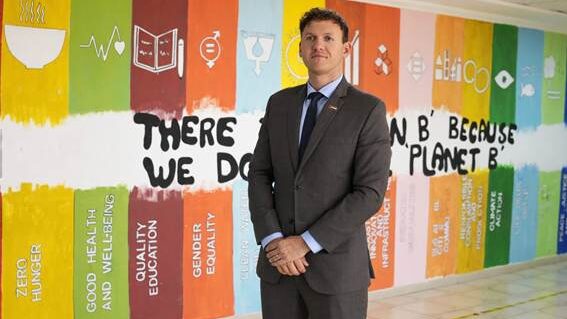
Tom Powell’s journey into climate and sustainability education grew out of an upbringing shaped by entrepreneurship, long-term thinking, and work designed to endure.
For more than forty years, his family has operated businesses across the Middle East, delivering projects for public institutions and royal clients. Growing up in this environment gave Tom an early understanding of how credibility is built in the region: through consistency, long-term thinking, and impact measured over time.
His grandmother was a ceramic artist whose work became embedded in civic buildings and public spaces across the Gulf region. For Tom, this was an early lesson in how creativity, culture, and enterprise can shape communities in lasting ways, an influence that continues to inform his approach to education today.
That same belief now underpins One Earth Academy, the organisation Tom founded to embed sustainability into learning systems from an early age, and its flagship schools programme, Climate Kids Academy. He believes sustainability only delivers meaningful impact when it is built into long-term structures, rather than approached as a short-term initiative.
From Renewable Energy to Education
As Tom’s career developed, his work sat at the intersection of education, professional training, and renewable energy. Across these sectors, he observed a consistent challenge: policies and technologies often fail not because they are flawed, but because people are not equipped to understand, apply, or sustain them.
This was particularly evident in the renewable energy sector. Technical solutions existed, but widespread adoption depended on effective training, behaviour change, and trust. Making complex sustainability concepts practical, accessible, and immediately useful became central to Tom’s work.
Prior to founding One Earth Academy, Tom built an education and training business focused on the renewable energy sector, growing it from concept to an internationally recognised provider. The challenge was not innovation, but credibility and communication, ensuring learning was clear, relevant, and grounded in real-world application.
That experience shaped a core belief that underpins One Earth Academy today: education only drives change when it is practical, measurable, and designed to influence long-term behaviour. Climate action cannot rely on information alone; it requires learning experiences that shape habits, decision-making, and systems thinking.
The Birth of Climate Kids Academy
Climate Kids Academy emerged from a clear gap. While awareness of climate change was increasing, schools lacked structured programmes that aligned sustainability education with inspection frameworks, national strategies, and measurable impact.
As the flagship programme of One Earth Academy, Climate Kids Academy was designed as a whole-school system, running from Kindergarten through to Year 12, embedding sustainability across subjects rather than isolating it as a single topic. The programme blends digital learning, teacher support, and experiential projects, enabling schools to demonstrate clear intent, implementation, and impact.
The modules are age-appropriate, curriculum-aligned, and flexible, allowing schools to integrate sustainability into existing teaching without adding pressure to already crowded timetables. Schools are supported to deliver meaningful learning while generating evidence that meets inspection and reporting expectations.
Turning Learning Into Action
What distinguishes Climate Kids Academy is its emphasis on experience. Students do not simply learn about climate and sustainability; they take part in projects that reduce waste, monitor energy use, support biodiversity, and engage with their communities.
This approach reflects a simple belief: people change when learning becomes personal. Experiential learning allows students to see themselves as contributors rather than passive recipients of information. Over time, this builds confidence, responsibility, and long-term habits.
For schools, the benefit goes beyond engagement. The programme creates measurable outcomes that can be documented and reported, supporting inspection readiness and demonstrating progress against sustainability commitments.
Scaling Across the UAE, the UK and the Middle East
Today, Climate Kids Academy is already being delivered and embedded globally, with active programmes across the UAE, the UK, and the wider Middle East, while continuing to expand into additional international markets — all while maintaining a consistent core mission.
Schools adopt the programme as a whole-school approach, embedding sustainability across year groups rather than treating it as a standalone initiative .Schools implement the programme through a whole-school approach, integrating sustainability throughout various year groups instead of viewing it as a separate initiative. This ensures learning is progressive, coherent, and visible across the school community.
At Bright Riders in the UAE, the programme has been implemented across the whole school system, supporting students from early years through to secondary education while actively driving the school towards a more sustainable future.
As Latika Narain, Principal of Bright Riders School, Dubai, explains:
“There are many features that make the Climate Kids Academy programme highly appealing. First, the design and structure of the modules are comprehensive and user-friendly. Second, the modules are customised to be country-specific while also offering a global perspective, making them extremely engaging and relevant.”
Alongside the digital platform, experiential learning is delivered through school-based projects, community initiatives, and early exposure to green career pathways, ensuring sustainability education remains grounded in real-world opportunity.
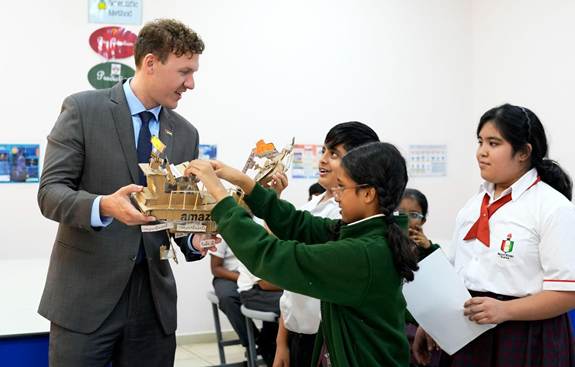
Bright Riders School – Shark Tank Innovation Activity
Building a Pipeline for the Green Economy
A central ambition behind Climate Kids Academy is to support the long-term transition to a low-carbon economy by developing skills, understanding, and motivation from an early age.
By linking sustainability education with future pathways in renewable energy, environmental science, and green industries, the programme helps students see how learning connects to opportunity. This supports national workforce strategies while empowering young people to imagine a future for themselves in the green economy.
Education, when aligned with economic transition, becomes a strategic asset rather than a peripheral concern.
Responding to a Rapidly Changing Education Landscape
Behind the expansion of Climate Kids Academy is a clear recognition that schools are under growing pressure to act now. Inspection frameworks are evolving rapidly, and governments are raising expectations around sustainability, climate literacy, and global citizenship. Schools are no longer being assessed on intent alone, but on how effectively these priorities are embedded, delivered, and evidenced in practice.
As part of One Earth Academy, Climate Kids Academy was developed to help schools respond to this shift with confidence, providing a structured, inspection-ready approach that aligns learning with policy, accountability, and long-term national goals, while remaining practical and achievable at school level.
Embedding Sustainability for the Long Term
For Tom Powell, impact is not personal. It is systemic. If sustainability becomes a natural part of every child’s learning journey, and if schools are empowered to deliver it with confidence and evidence, then the work has succeeded.
Through One Earth Academy and its flagship programme, Climate Kids Academy, this vision is already taking shape, embedding sustainability into education systems from Kindergarten through to Year 12, aligned with national priorities and built to endure.
When experiential learning is combined with technology, strong values, and long-term thinking, education becomes one of the most powerful tools for shaping societies, not through noise, but through impact that lasts.
Do follow on Instagram and Linkedin.
Also Read – 7 Amazing Traditional Kuwaiti Food Dishes You Must Try

